

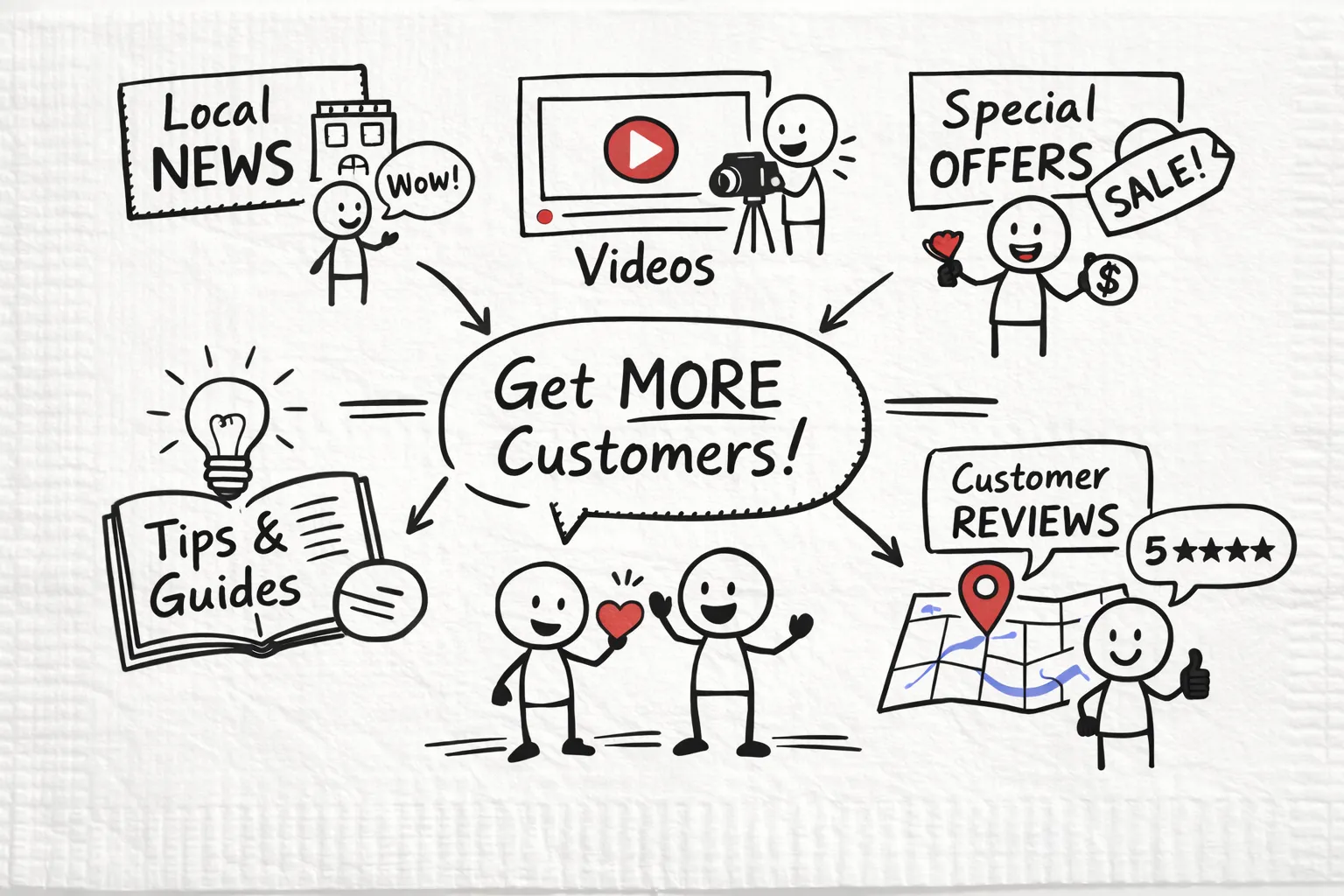
If you've been wondering what type of content a local business should create to attract customers, you're asking the right question, and you're not alone. Most local businesses post when they have time, not when they have a plan. The result is random content that gets ignored, a follower count that refuses to move, and a growing suspicion that social media just doesn't work for them.
In our experience at Stellar Media Marketing, content type is often the primary problem. Platform and posting frequency matter too, but we consistently see businesses that have those details sorted still struggling, because they're posting the wrong type of content for where a local audience actually is in the buying decision. It's the single most common pattern we see when a new local business client walks through the door: great businesses with real value to offer, buried under inconsistent content that doesn't connect.
This article breaks down five content types proven to attract nearby customers, explains why each one works, and gives you a clear sense of how to prioritize them for your specific business. No guessing, no burnout, and no expensive tools required.
1. Behind-the-scenes content builds trust before a sale
Most people scroll past perfectly staged brand photos because they feel like ads. A quick video of your team prepping for a job, or a photo of your shop before opening, feels real. That realness is exactly what builds trust with local buyers who haven't met you yet, and trust is what gets you the call.
The psychology here is straightforward: local customers are choosing a person, not just a product. They want to know who they're handing money to before they ever book a call or walk through your door. Behind-the-scenes content answers that question before they even have to ask it.
For a contractor, this looks like a time-lapse of a project in progress, a "before the crew arrives" morning routine, or a walk-through of a finished job. For a boutique or café, it's the process of restocking, a sneak peek at a new menu item, or a staff prep moment before opening. Short-form video performs best here: according to Facebook's own platform data, live video generates six times more interactions than static posts, so even a casual phone video from your workspace can earn strong organic reach on platforms like Instagram Reels and Facebook.
2. Customer testimonials let your best clients do the convincing
A business promoting itself is expected. A customer endorsing a business is proof. This distinction matters enormously for local buyers who are deciding between you and three competitors within driving distance. According to BrightLocal's consumer research, roughly 76% of consumers trust online reviews as much as personal recommendations from people they know, which means your existing happy clients are one of your most powerful marketing assets.
Video testimonials can increase engagement and perceived authenticity compared with static text reviews, but even a well-formatted screenshot of a five-star Google review posted to Instagram adds real credibility. The format matters less than the consistency of showing social proof. One testimonial posted regularly each month does more for your reputation than a wall of reviews that visitors scroll past without reading.
The best time to ask for a testimonial is immediately after delivering a result your client is visibly happy with. A simple follow-up message asking for a Google review or a short video response removes the friction most people feel about writing something formal.
Where to distribute testimonials for maximum impact
Distribute social proof across your Google Business Profile for local SEO signals, Instagram Stories for visibility, and pinned Facebook posts for long-term reach. Customer reviews on your Google Business Profile directly influence local pack rankings and "near me" search results, which means this content type does double duty for your localized content strategy without extra effort.
3. Local event tie-ins and community spotlights put you on the map
Posting about a local event, tagging a neighboring business in a shoutout, or featuring a community member in a spotlight post does something no paid ad can replicate: it positions your business as part of the fabric of the neighborhood. People buy from businesses they feel connected to, not just businesses they've seen online, and community-focused content creates that connection in a way that promotional posts simply cannot.
A local bookstore that started publishing blog posts about upcoming literary events in its area saw a meaningful increase in store visits and positioned itself as a community hub rather than just a retail location. Content drove that shift without a single dollar spent on advertising. The same principle applies to a plumber sponsoring a youth sports team, a landscaper featuring a neighborhood before-and-after, or a restaurant spotlighting a local supplier.
Event tie-ins work best when you comment on local happenings, share what's coming up in your area, or document a community event you sponsor. Community spotlights work when the focus stays on the other person or organization, not on you. The trust transfer happens naturally when your audience sees who you associate with. These posts also create natural backlink opportunities when local organizations share your mention, which strengthens your local SEO authority beyond social engagement alone.
4. Educational how-to content turns local searches into leads
Educational content works because it meets people at the exact moment they're actively trying to solve a problem. A homeowner searching "how to know when to replace a water heater" is one click away from needing an HVAC company. If your how-to post answers that question clearly and honestly, you're already the most credible option before they ever call anyone.
The data supports this investment in local content marketing. Infographics and how-to content receive three times more shares than standard blog posts, and video tutorials drive 88% more time on page (Wyzowl, HubSpot). Both signals tell search engines your content is worth surfacing, and they keep potential customers in your orbit longer than any promotional post ever could.
The key to making educational content work locally is geographic framing. "How to winterize your pipes in Aurora, Colorado" ranks better locally than a generic version of the same topic. Adding that geographic context directly in the title and first paragraph tells Google exactly who this content is for. Location-specific pages with educational sections consistently rank among the top-performing local SEO content types for improving Google Maps visibility.
5. A consistent content mix is what actually converts followers into customers
Creating content while running a business is exhausting. Most owners default to posting whatever feels easy that week, which means the mix ends up unbalanced: too many promotional posts, almost no trust-building content, and zero local connection. The result is a social presence that feels like a bulletin board instead of a relationship, and bulletin boards don't build businesses.
The fix isn't posting more. It's posting strategically. A content mix that rotates between behind-the-scenes content, testimonials, community tie-ins, and educational posts gives the algorithm consistent signals and gives your audience a reason to keep following you. Research consistently points to two to five posts per week across your primary platform as the sweet spot for most local service businesses: enough to stay visible without sacrificing quality. For recommendations on posting cadence across platforms, see this guide to ideal social media posting frequency.
Here's a simple starting rotation to test against your own analytics:
- Monday: Educational tip or how-to relevant to your service
- Wednesday: Behind-the-scenes moment from your team or process
- Friday: Customer testimonial, community spotlight, or local event tie-in
This isn't a rigid formula. It's a starting framework. The goal is never to post more; it's to post the right things in the right order so each piece of content serves a specific role in building trust and attracting nearby customers.
How to start without burning out
The most common mistake local businesses make after reading a list like this is trying to implement all five content types at once. That's the fastest path to burnout and inconsistency. Instead, pick two or three that fit your business naturally and commit to producing them consistently for 30 to 90 days. Track which ones generate the most engagement, inquiries, and foot traffic, then build from there.
If you already have strong word-of-mouth but a weak digital presence, start with testimonials and behind-the-scenes content. They convert existing trust into online proof. If you're newer to your market and need to build awareness, lead with educational content and community tie-ins. They generate reach with an audience that doesn't know you yet.
What type of content should a local business create to attract customers?
Content strategy isn't a nice-to-have for local businesses. It's the foundation that makes everything else, ads, local SEO, and word-of-mouth, work harder. The five content types covered here each serve a specific job in the buyer's journey. Behind-the-scenes posts build familiarity. Testimonials build credibility. Community content builds belonging, and educational content builds authority. Used together in a consistent mix, they build a local brand that actually grows.
If you're tired of guessing what to post and want a content plan built specifically for your local business, Stellar Media Marketing starts every engagement with a foundation-first strategy session, not just a posting schedule. Content that doesn't reflect your brand, your audience, and your goals is just noise, and a real content strategy is one of the highest-return investments a local business can make. Reach out to Kelly and the team to get a strategy built on solid ground.