

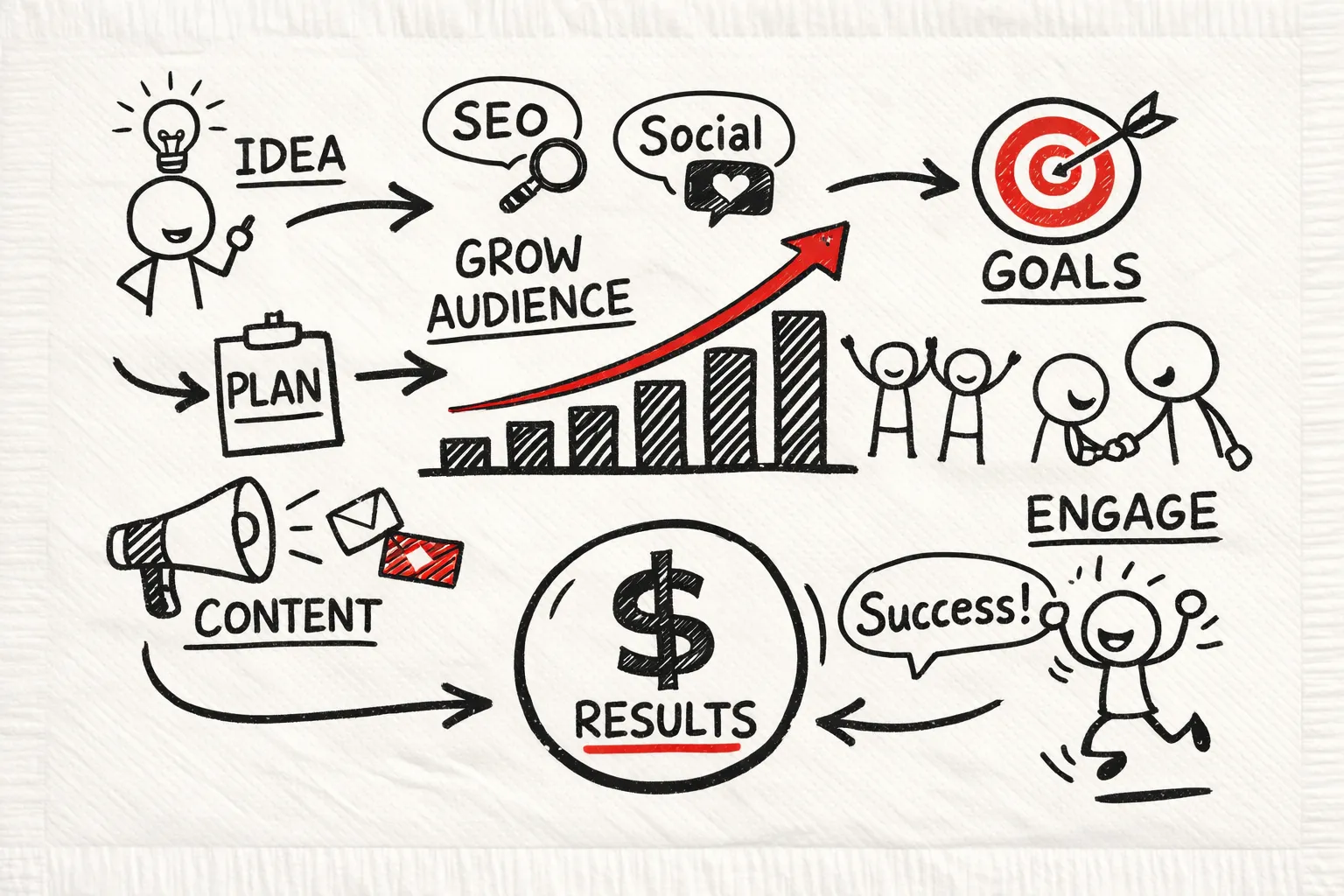
You've been posting consistently for months. You show up, you share content, you try different formats. And yet the leads aren't coming. The followers aren't converting. You're not even sure which posts are working and which ones are just noise. The problem isn't your effort, it's the absence of a plan built around your specific goals, your specific audience, and what you can realistically sustain. Many small businesses face exactly this gap: consistent activity without a coherent strategy underneath it.
If you're researching how to create a content marketing strategy for small businesses, the most important thing to understand is that this doesn't require a big budget or a marketing degree. It requires clarity and sequence. Some business owners work this out through years of trial and error. Others accelerate the process by partnering with a team like Stellar Media Marketing, a digital marketing agency that offers coaching, strategy development, and content support, structured to meet businesses at different stages and budget levels. But whether you go it alone or bring in support, the framework is the same.
These 7 steps will walk you through building a strategy that fits your budget, your audience, and your bandwidth. Follow them in order. The sequence matters more than it might seem, because each step builds the foundation for the next, and skipping ahead is where most content plans quietly break down.
Start with goals and audience before you create a single piece of content
Most small businesses skip straight to asking "what should I post?" before they've answered "who am I talking to and what do I need this content to do?" That backwards approach is why so many content efforts feel like spinning wheels. A real small business content strategy starts with two decisions that everything else depends on.
Step 1: Set goals tied to real business outcomes
Vague goals produce vague results. "Grow awareness" is not a content goal. "Generate 15 qualified leads per month from organic search within 90 days" is. The more specific your goal, the easier it becomes to measure progress and choose the right content formats later.
Your goals should also reflect your business stage. A brand-new business needs content that builds trust and introduces what it does. A five-year-old business with an established audience needs content that converts interest into bookings or purchases. These require different approaches, and collapsing them into one generic strategy is where most plans fall apart.
Step 2: Build a buyer persona specific enough to be useful
A useful persona goes well beyond age and location. You need to know the actual questions your audience types into Google at 11 p.m., the problems keeping them up at night, and where they spend time online. That specificity is what makes your content feel written for someone rather than aimed at everyone.
One specific persona beats five vague ones every time. If you serve homeowners looking for a reliable contractor, your persona isn't "homeowners aged 30, 55." It's "a first-time homeowner in a growing suburb who is overwhelmed by conflicting contractor quotes and wants reassurance that she's making the right choice." That level of detail changes everything about how you write and what topics you cover.
How to create a content marketing strategy for small businesses: choose the right channels and build your content pillars
Choosing platforms before you know your audience is one of the most common and costly mistakes small businesses make. The goal isn't to be everywhere. The goal is to show up consistently in the places where your specific audience actually spends time.
Step 3: Pick two or three platforms and own them
Email marketing delivers between $36 and $42 per dollar spent, according to data from the Data & Marketing Association, and consistently ranks as the highest ROI channel for small businesses. Short-form video leads all media formats in ROI, with nearly half of marketers ranking it in their top three, according to HubSpot's annual State of Marketing report. For local service businesses in early growth stages, organic social and a simple blog often outperform paid campaigns when budget is limited.
Start with one primary channel and one secondary channel. B2B businesses and professional services tend to see the strongest results on email and LinkedIn. B2C local businesses, especially in home services and contracting, regularly outperform on Instagram Reels and Google Business content. According to Rival IQ's 2023 Social Media Industry Report, Instagram engagement rates in construction and home services sectors can exceed 5%, and Nextdoor can be a powerful hyper-local addition for neighborhood-focused businesses.
Step 4: Define three to five content pillars that anchor every post
Content pillars are the recurring themes your content lives inside. They eliminate the "what do I post today?" paralysis that causes most content strategies to quietly die after three weeks. Good pillars for service businesses include Problem-Solving Guides, Client Results and Transformations, Community and Local Stories, and Buying Advice that addresses common objections.
Your pillars should connect directly back to the persona you built in Step 2. If your buyer is stressed about choosing the right contractor, a "Buying Advice" pillar that demystifies your process is doing real strategic work. Each pillar also gives you a framework for batching content, which becomes critical when you build your calendar in the next step.
Build your 90-day content calendar
This is where planning becomes execution, the 90-day calendar is the bridge between having a plan and actually running one. Without a calendar, the strategy stays a document that lives in your Downloads folder.
What a realistic publishing cadence actually looks like
A weekly schedule you can sustain for 12 weeks is worth far more than an ambitious daily schedule that collapses in week three. For a solo service business owner, a suggested starting cadence looks like this: one blog post every two weeks, three social posts per week, and one email per week. That's manageable, and it compounds over time.
The 90-day calendar works best when you structure it as three 30-day blocks. Each block has a theme, a primary audience focus, and a publishing schedule. You don't plan all 90 days in detail on day one. You plan the first 30 in full, sketch the next 30, and leave the third block open for adjustments based on what you learn.
How to run your 30-day review cycles
At the end of each 30-day block, spend 20, 30 minutes reviewing what happened. What content drove the most clicks? What flopped? What theme performed above average? These questions don't require a data science background. They require consistent attention to a small set of numbers.
For tools, start free. A Google Sheet with columns for date, platform, topic, status, and results is enough to run this system for months. Notion works well for teams that want a visual calendar view. You don't need paid software until the volume of content justifies it.
Create content efficiently with a repurposing workflow
The biggest threat to a content strategy isn't bad strategy. It's burnout. Owners who set ambitious plans and then try to create everything from scratch every week eventually run out of time and energy. A repurposing workflow is what makes your content plan sustainable.
The core repurposing workflow for solo owners and small teams
The most effective repurposing workflows follow five steps:
- Plan with repurposing in mind from the start
- Create source content that breaks apart cleanly
- Transform that source into smaller formats
- Schedule distribution across channels
- Track results to know what's worth repeating
In practice, one long-form blog post becomes three social posts, one email, and a short Reel, five pieces of content from a single original asset.
The key is building the repurposing plan before you create, not after. When you write a blog post knowing you'll pull three quotes for social and one key stat for an email, you write differently, and more efficiently, from the beginning. Structured templates and AI writing tools can further reduce the time required to adapt content across formats.
Tools worth using without a big budget
For solo operators, three tools cover most repurposing needs: Opus Clip for pulling short clips from longer videos, Descript for converting audio and video into text and snippets, and Canva for visual repurposing across formats. That combination handles the majority of what a small content operation needs without significant cost.
Repurpose.io is worth evaluating when you're producing regular video content and want automated distribution to multiple platforms. Keep your tool stack minimal. Adding more tools than you'll actually use creates friction, and friction is the enemy of consistency. If you're weighing whether to do content repurposing yourself or pay for done-for-you services, the differences are well outlined in the do-it-yourself vs done-for-you content repurposing discussion.
Track the right KPIs and stop watching vanity metrics
Without measurement, a content plan is just intention. Tracking closes the loop between effort and outcome, and it's what separates a content marketing strategy from a content marketing system. A system improves over time. A strategy without measurement just sits there.
The KPIs that actually connect to business goals
Focus on four core metrics, each tied directly to the business outcomes you defined in Step 1:
- Organic traffic growth, aim for 20, 30% year-over-year
- Conversion rate on lead gen content, a benchmark range of 2, 5%
- Email click-through rate, 0.5, 2% is a solid target
- Bounce rate, under 50% is your goal
For tools, Google Analytics handles traffic and on-page metrics. Native platform insights cover social engagement. You don't need a third-party analytics platform at early stages. What you do need is a habit of checking the same numbers at the same time each month so you can spot patterns.
A simple framework for monthly reporting
Once a month, spend 20 minutes reviewing three things: total traffic and how it changed, conversion rate on your primary content goal, and which content theme drove the most engagement. Write the answers in a single row of a tracking spreadsheet. Over six months, that spreadsheet becomes one of the most valuable assets in your business, it shows you what's working before you've wasted months going in the wrong direction.
Don't wait for perfect data before you start. Pattern recognition comes from consistent tracking over time, not from a dashboard that's fully built before you publish your first post.
Know when to DIY your strategy and when to get support
Not every small business needs to hand over full control to an agency. And not every business owner has the time or skill set to build and run a content strategy alone. The smart move is knowing where you actually are, not where you think you should be.
What tiered content marketing support actually looks like
There's a middle ground between doing everything yourself and writing a large monthly check for done-for-you content. Some owners want a monthly supply of content prompts to spark ideas and keep them moving. Others want plug-and-play templates they can customize with their own voice. And some are ready for fully bespoke content that's researched, written, and formatted to convert.
At Stellar Media Marketing, the content support model is built around exactly this kind of flexibility. You stay in control of your brand voice, but you stop grinding through a blank content calendar every week alone. Whether you need prompts, templates, or finished pieces, the goal is the same: content that earns attention and drives real business results, built on a strategy designed for your specific goals and audience first.
Signs you've outgrown the DIY approach
Three situations tend to signal that outside support will pay off. The most common is posting consistently without converting, which usually means the strategy layer is missing even if the execution is solid. Another is having a good strategy but genuinely lacking the time to execute it. The third is never having done a formal content audit, leaving you unsure what's working or why.
In any of these situations, bringing in an experienced strategist can compress years of trial and error into a focused 90-day plan that fits your actual bandwidth, and that kind of acceleration tends to justify the investment quickly.
How to create a content marketing strategy for small businesses: start before it's perfect
A content marketing strategy for a small business isn't complicated, but it does require intentional sequencing. You don't need a smart content marketing on a budget for small businesses or a full marketing team. You need clarity on your goals, your audience, and your channels, and then a system that shows up consistently and measures what matters.
Building that system takes time, but these 7 steps give you a clear starting point. Goals first. Audience second. Channels and pillars third. Calendar, repurposing workflow, and KPI tracking after that. And then honest self-assessment about where you need support.
Pick one step from this list and take action on it today. Not tomorrow, not after you finish planning. Today. A plan that launches imperfectly is far more valuable than a perfect plan that never gets off the ground.