

Last updated: September 2026 · By Kelly Noble Mirabella, Fractional Social Media Director, co-author of AI Chatbots for Dummies, and Founder of Stellar Media Marketing (Aurora, CO)
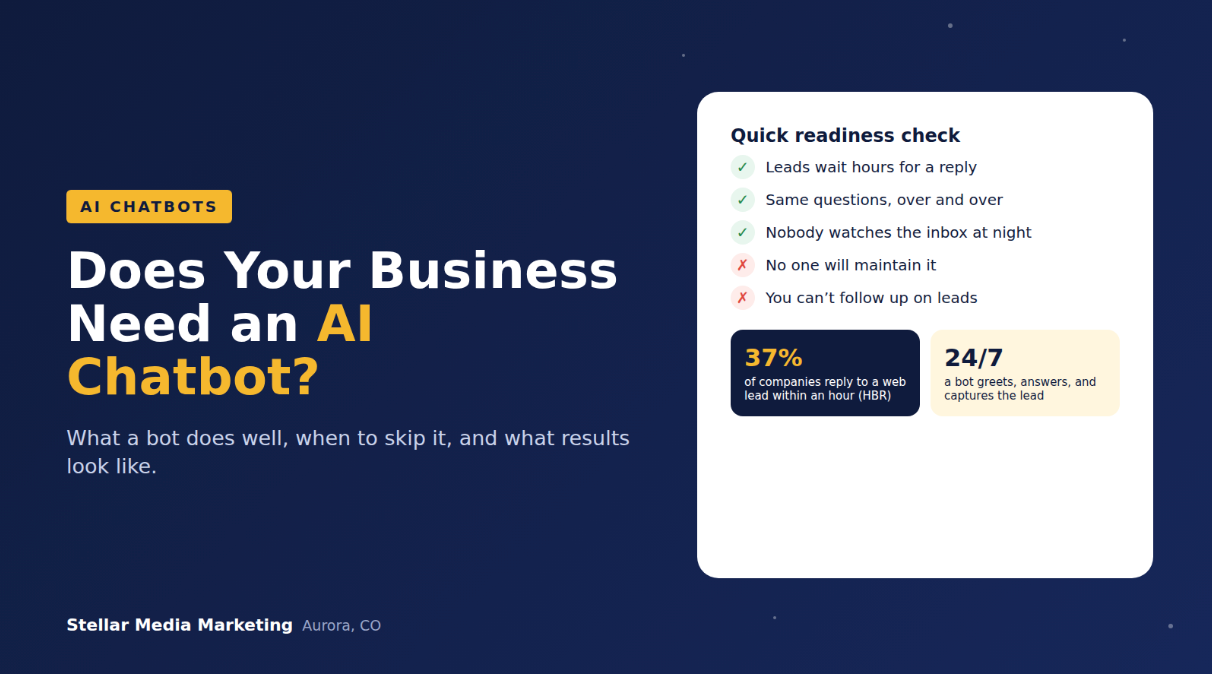
Quick answer: Your business needs an AI chatbot if you lose leads to slow replies, get the same questions over and over, or nobody watches your inbox after hours. Even low message volume justifies one: a Harvard Business Review study of 2,241 companies found only 37% responded to web leads within an hour. A bot answers instantly while you're on a job site.
I've built chatbots for years, co-authored AI Chatbots for Dummies for Wiley, and created Baby Got Bot to teach this stuff. Here's the honest version of when a chatbot pays off and when it just annoys people.
What does an AI chatbot actually do for a small business?
An AI chatbot greets visitors, answers common questions, and collects the information you need to follow up, on your website and on Facebook and Instagram. Think of it as a digital receptionist rather than a replacement for your team.
The main jobs it does well:
- Answers repeat questions. Hours, service area, pricing ranges, warranty, what to expect.
- Captures leads. Name, contact info, project type, and timeline, even at 11 p.m.
- Routes urgent messages. A real lead can trigger a text to you instead of sitting in an inbox.
- Delivers content. Guides, price sheets, and videos sent straight into the chat.
- Turns comments into conversations. On Instagram and Facebook, a keyword in a comment can start a DM.
- Hands off to a human. The good ones know when to stop and get you.
When is a chatbot worth it?
A chatbot is worth it when messages are getting missed, not just when volume is high. This is the part most businesses get backwards.
One of my clients, a residential pool builder, had a three-person team running everything. Messages trickled in at a low, inconsistent volume, so they were often missed or left unanswered for days. Nobody was being lazy. They were busy building pools.
We put in an AI chatbot trained on their business that could also read intent. When someone showed interest in a quote, the bot knew what details to collect, then an automation texted the lead straight to the client and to me. Once it was in place, they never missed another message, and the customer experience improved immediately.
"People think chatbots are for companies drowning in messages. The businesses that get the most out of them are small teams who can't watch the inbox all day. Missing one message a month can cost more than the bot does." Kelly Noble Mirabella, co-author of AI Chatbots for Dummies
Speed is the whole game. That Harvard Business Review study found companies that contacted a lead within an hour were nearly seven times as likely to qualify it as those that waited even one more hour. A bot doesn't wait.
What results can a chatbot produce?
Results vary, but here are three real examples, including two from my own book research:
- A residential pool builder (my client). What they did: AI bot trained on the business, intent detection, instant text alerts on hot leads. Result: Stopped missing messages entirely.
- Get Matt's Deals. What they did: Comment automation delivering links by DM instead of "link in bio". Result: Sales up 40%, post engagement nearly doubled.
- Suitor (menswear, Australia). What they did: Support chatbot handling routine inquiries. Result: 68% of inquiries handled automatically, 31% increase in monthly revenue.
Matt, the e-commerce influencer behind Get Matt's Deals, put it this way: "Automation allows my audience to get what they are wanting quick and easy without having to wait for me to send them a link or have to try to navigate my website or Amazon storefront just to find the product from my post."
When does a chatbot not make sense?
Skip it, or keep it very simple, if any of these are true:
- Nobody will maintain it. A bot trained once and forgotten gives wrong answers, which is worse than no bot.
- Your business runs on complex, custom conversations where a bad answer costs you trust. Use it to capture and route instead of to advise.
- You can't follow up. A bot that collects leads nobody calls is an expensive way to disappoint people.
- Your website has bigger problems. If your site doesn't explain what you do or where you work, fix that first.
A chatbot amplifies your operations. If follow-up is broken, it amplifies that too. That's one of the signs your marketing isn't working.
What makes a good chatbot?
Six things separate a bot people like from a bot people close:
- Train it on your real business. Services, service area, pricing ranges, policies, and the questions you actually get.
- Give it a job. Booking, quoting, support, or content delivery. Pick one primary goal.
- Make it sound like you. Same voice as your website and your social media.
- Detect intent. When someone wants a quote, collect what you need to give one.
- Alert a human fast. Text or email on hot leads, with an easy handoff to a person.
- Review the transcripts monthly. Every conversation shows you what customers ask and where the bot gets stuck.
That last habit is the one people skip, and it's the one that makes a bot better over time.
Where should your chatbot live?
Put it where your customers already message you.
- Your website. Best for quotes, bookings, and support questions.
- Facebook and Instagram. Best for turning comments and DMs into conversations, especially if social is where you get discovered. Pew Research Center's 2025 survey found 71% of U.S. adults use Facebook and 50% use Instagram.
I build AI chatbots for both: websites and Meta platforms like Facebook and Instagram. If you want to talk through whether one fits your business, book a discovery call or see my services.
Frequently asked questions
How much does an AI chatbot cost for a small business?
It depends on scope: how many questions it handles, which platforms it lives on, and how deeply it integrates with your CRM or scheduling. Build cost is separate from the monthly platform fee. Ask for both numbers before you commit.
Will a chatbot annoy my customers?
Only if it's bad. People get annoyed by bots that loop, dodge the question, or hide the path to a human. A well-trained bot that answers quickly and hands off cleanly usually improves the experience.
Can a chatbot replace my customer service?
No, and it shouldn't. It should handle the repetitive questions and capture information so your team spends time on the conversations that need a human.
Do chatbots work on Facebook and Instagram?
Yes. On Meta platforms, chatbots can answer DMs and respond to comments with a keyword trigger, which is a popular way to deliver a guide or link without sending people to a bio link.
What should my chatbot say first?
Greet the person, say what you can help with, and offer two or three clear options, like "get a quote," "see our work," or "talk to a person." Clarity beats cleverness.
How do I know if my chatbot is working?
Track conversations started, questions answered without a human, leads captured, and how many of those leads became customers. Read the transcripts monthly and fix what the bot fumbles.
Changelog: September 2026, first published.