

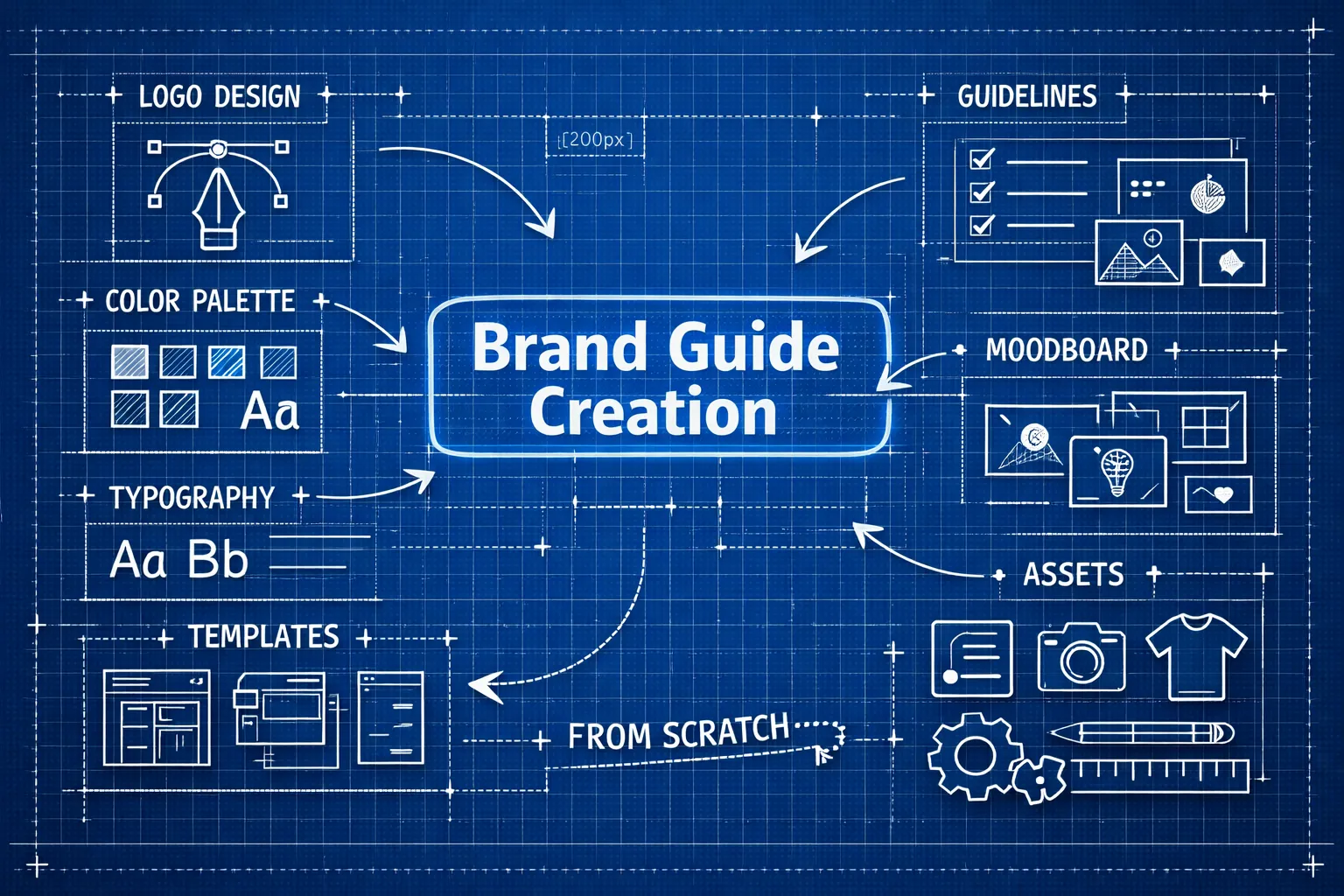
Many businesses invest heavily in content, ads, and design work, only to end up with execution that looks and sounds inconsistent across every channel, because no single document exists to keep everyone aligned. A freelance designer uses the wrong logo version; a new hire sends a proposal in the wrong colors; a social media manager writes in a tone that doesn't match the website. Each of these mistakes is preventable, and they all trace back to the same missing piece: a brand guide. Learning how to create a brand guide is one of the highest-leverage things a growing business can do.
A brand guide, sometimes called a brand style guide or brand standards document, is the reference that tells every designer, writer, and marketer exactly how to represent your business visually and verbally. It's not a mood board. It's not a logo file. It's a working document that answers the question "Is this on-brand?" before anyone has to ask. At Stellar Media Marketing, no content gets produced for a client until a brand guide is in place first, it's a firm standard built into every client engagement. A foundation-first approach helps brands build recognition over time; research and best-practice frameworks consistently recommend documenting mission, values, and voice before any design or content work begins.
This article walks you through six steps to build a complete brand guide from scratch: starting with your brand foundation, documenting your visual identity, setting imagery standards, writing your voice and tone guide, choosing the right tools and templates, and keeping your guide alive after you publish it.
1. Start with your brand foundation, not your logo
Most people reach for their logo file first. That's the wrong starting point. A brand guide built on visual decisions alone falls apart the moment someone asks, "What should we say here?" The foundation of every strong brand style guide is the written core: who you are, why you exist, and who you serve.
Define your mission, vision, and core values
Your mission states what you do and for whom. Your vision describes where you're going. Your core values are the non-negotiables that shape how you operate. These three elements belong at the front of any brand book because they inform every decision that follows. A brand that values simplicity, for example, will choose clean typography, minimal color palettes, and plain-spoken copy. One that values bold innovation will make completely different choices.
Keep these definitions short and specific. A mission statement that says "we help businesses grow" tells a designer nothing. One that says "we help service-based businesses in the Denver area build digital marketing systems that replace inconsistent guesswork with a plan that earns real customers" gives everyone on your team something to work from.
Identify your target audience and brand personality
Your brand guide should include a clear description of your audience: their demographics, the problems they're trying to solve, and the language they actually use. This section isn't just a reference tool for content writers. It also tells a designer whether visuals should feel sophisticated or approachable, corporate or neighborhood-friendly.
From that audience understanding, distill your brand personality into 3 to 5 descriptive traits. Words like "direct, warm, expert" or "bold, approachable, grounded" serve as the bridge between your values and your visual choices. Every decision about color, font, and imagery should reflect those adjectives.
How to Create a Brand Guide: Document Your Visual Identity
Once your brand foundation is written, visual identity rules follow naturally. This is the section most people picture when they imagine a brand style guide. It covers how your logo, colors, and typography must be used, not just what they look like.
Logo usage: clear space, minimum sizes, and acceptable variations
Clear space is the protected margin around your logo that prevents other design elements from crowding it. Define this measurement in your guide, typically as a proportional unit based on the logo's own dimensions. For digital use, we recommend a minimum height of 24px; for print, a minimum width of around 1 to 1.5 inches covers most standard applications. Your guide should also specify which logo variations are approved, such as full-color, single-color, and reversed versions, and which contexts each is appropriate for. For a practical reference on measuring clear space and minimum sizes, consult university-level brand resources that explain proportional measurement in detail.
Prohibited uses are just as important as approved ones. State explicitly that the logo cannot be stretched, recolored outside approved palettes, placed on clashing backgrounds, or surrounded by competing visual elements. Showing a visual example of each prohibited use makes this section immediately practical.
Color palette: HEX and RGB codes, WCAG contrast, and usage rules
Document every color in your primary and secondary palette with all necessary codes: HEX and RGB for digital and screen use, CMYK for print, and Pantone for physical materials like signage or merchandise. This prevents the common problem of color drift across different designers and vendors.
Accessibility belongs in your brand guide, not as an afterthought. Per WCAG 2.1 and 2.2 (Success Criterion 1.4.3), the minimum contrast ratio is 4.5:1 for normal text and 3:1 for large text at Level AA. Identify which of your brand colors are approved for text use versus decorative accents only. A brand color that looks stunning as a background element may fail accessibility standards as a text color, and your guide should make that distinction explicit. For more detail on how WCAG treats color contrast and practical implementation, review the WCAG color contrast accessibility guidelines.
Typography: hierarchy, pairing rules, and sizing
Specify your heading font, body font, and any accent font with clear rules for each. Include size ranges for headings versus body copy, line spacing guidance, and what to use when primary brand fonts aren't available on a given platform. A web developer working with system fonts needs to know the fallback options. A social media manager creating graphics needs to know whether bold and italic are permitted. These are the details that keep typography consistent across every touchpoint.
3. Set your imagery and design standards
Photography, illustration, and iconography communicate just as loudly as a logo. Without documented standards, your visual identity can split in two directions the moment two different team members select stock photos for the same campaign. One picks warm, natural-light lifestyle images; the other selects cold, heavily filtered composites. Both are technically "professional," but neither looks like the same brand.
Photography and illustration style guidelines
Write your imagery rules around mood, subject matter, color grading, and what to avoid. If your brand uses natural light and people-focused imagery, say so explicitly. If certain visual clichés are off-limits, such as generic handshake photos or oversaturated filters, name them. The goal is to give anyone sourcing images a clear filter for what passes and what doesn't.
Dos and don'ts with visual examples
Abstract rules only go so far. The most effective brand guides include a visual dos/don'ts section that shows correct and incorrect applications side by side for logo placement, color usage, typography, and photo choices. This is the section that actually stops mistakes before they happen, because it removes interpretation from the equation. A designer can argue with a written rule; it's much harder to argue with a clear comparison visual.
4. Write your brand voice and tone guide
A brand that looks consistent but sounds different every week still loses trust. The voice and tone section of your brand guidelines document is what makes written content feel unmistakably on-brand, whether it's a social post, an email subject line, or an about page. Many businesses omit this section entirely, which is why so many of them read like they were written by five different people. For practical definitions and examples, see a dedicated guide on brand voice to help translate personality into usable copy rules.
Define your core voice traits with "do/don't" language pairs
List 3 to 5 voice traits and explain each one using a do/don't phrase pair. This format transforms vague descriptors into usable guidance. Instead of saying "we are direct," write: "We are direct, not blunt. We simplify without talking down." Instead of "we are warm," write: "We are warm, not casual. We write like a trusted advisor, not a chatbot." These paired examples make the difference between a voice guide that sits on a shelf and one that a copywriter actually uses.
Adapt tone by channel with sample phrases
Voice stays constant; tone shifts based on context. Your core personality doesn't change, but how you express it should adapt to where you're showing up. Here's how that works across four channels:
- Web and blog: Informative, authoritative, detailed. "Here's a step-by-step framework to stop guessing and start growing."
- Email: Personal, direct, warmer. "You've been doing this without a strategy. Here's how to fix that in 30 minutes."
- Social media: Conversational, concise, engaging. "Your brand guide is the one document no one talks about but everyone needs."
- Ads: Punchy, benefit-driven, urgent. "Stop posting without a plan. Get the strategy that converts."
Include short sample phrases like these in your guide so a new team member or contractor can immediately understand the difference between writing for your email list versus your Instagram feed.
5. How to Create a Brand Guide: Tools and Templates That Actually Work
You don't need to start from a blank page. Choosing the right tools makes the process faster to execute and easier to maintain as your team grows. What works best depends on your team size, budget, and how widely you need to distribute your standards.
Free options: Canva templates and brand kits
Canva offers over 800 brand guidelines presentation templates, including multi-slide formats covering logos, colors, typography, and visual standards. The Brand Kit feature, available in Canva Pro, lets you store approved colors, fonts, and logo files so every team member pulls from the same asset library. Free templates are a solid starting point, but they require real customization to reflect your brand foundation. A template filled with placeholder text and random colors isn't a brand guide, it's a formatted document waiting to become one. Browse Canva's business guide templates and Brand Kit to find a starting layout you can adapt to your needs.
Platform tools for teams: Frontify and Bynder
For businesses with multiple designers, agency partners, or marketing team members, cloud-based brand management platforms like Frontify and Bynder offer a centralized place to store, share, and apply brand standards. Frontify focuses on customizable brand portals that make visual identity guidelines easy to navigate. Bynder handles asset management and creative workflows at scale. Both are better suited to mid-sized businesses or growing teams than to solo operators just starting out. For inspiration, review Frontify's brand guidelines examples.
When to hand this off to a professional
Some businesses need more than a brand guide template to fill in. If your brand hasn't been formally defined, your audience isn't clearly identified, or your current visual identity is inconsistent across platforms, no template will solve the underlying problem. When brand guide development follows a structured process, from values and audience definition through to documented design and content standards, agency pricing typically runs between $10,000 and $25,000 for a mid-tier engagement, based on current industry benchmarks.
At Stellar Media Marketing, brand guide development is part of a structured onboarding process that moves through values clarification, a full digital audit, strategy development, and then design and content execution. The result isn't a template filled with assumptions. It's a complete, usable guide built on your actual brand, your audience, and your business goals. If you're ready to build yours the right way, explore Stellar Media Marketing's branding services here.
6. Share your brand guide and keep it current
A brand guide that lives in a folder no one opens is worthless. Distribution and maintenance are what separate brands with real consistency from brands that just own a PDF they reference once and forget.
Onboard every team member and creative partner to your guide
When you bring on a new designer, copywriter, contractor, or social media manager, the brand guide should be part of their onboarding materials from day one. The most practical way to ensure this is to include the guide as a required attachment in your creative brief template. Anyone who receives a brief from you also receives the standards they need to execute it correctly. This habit significantly reduces the brand inconsistency that tends to surface when creative partners work in isolation without shared reference points.
Update your guide as your brand evolves
Brand guidelines need to be revised when you launch new products, shift your target audience, go through a rebrand, or simply recognize that your original rules no longer match where the business is going. Set a calendar reminder to review your guide at least once a year. A living document that gets updated to reflect your actual brand is worth far more than a perfect one that was accurate two years ago. Version your documents, date your updates, and communicate changes to anyone who works with your brand.
Build the foundation first, then build everything else
If you've been wondering how to create a brand guide that actually gets used, the answer starts before any design work happens. Each step in this process compounds the one before it, skip one, and the cracks show up in your content before you realize where the inconsistency started.
The guide itself is not a one-time design project. It's a strategic document that gets referenced every time a decision is made about how to represent your business. When that document is clear, specific, and actually used, your brand earns recognition instead of just spending money on content that doesn't compound.
If you're ready to build your brand guide but aren't sure where to start, or if your brand hasn't been formally defined yet, Kelly Mirabella and the team at Stellar Media Marketing work through a structured four-step foundation process that ensures your guide is built on solid ground before any design or content work begins. Learn more about Stellar Media Marketing's branding services and take the guesswork out of your brand foundation.