
Most small business owners haven't yet built a consistent brand identity for their small business, they often have a logo, a Facebook page, and maybe a color they like. But none of it connects. It feels random, forgettable, or worse, like it was thrown together on a Tuesday at midnight when someone finally decided the business needed to "look more professional." Sound familiar?
After 18 years of helping businesses build real authority online, I've seen this pattern repeat itself constantly. A brand isn't a logo. It's the whole system: what you look like, what you sound like, and what people feel when they interact with your business. The good news is that building a cohesive small business brand identity doesn't require a massive budget or a big agency. It requires a clear process, followed in the right order.
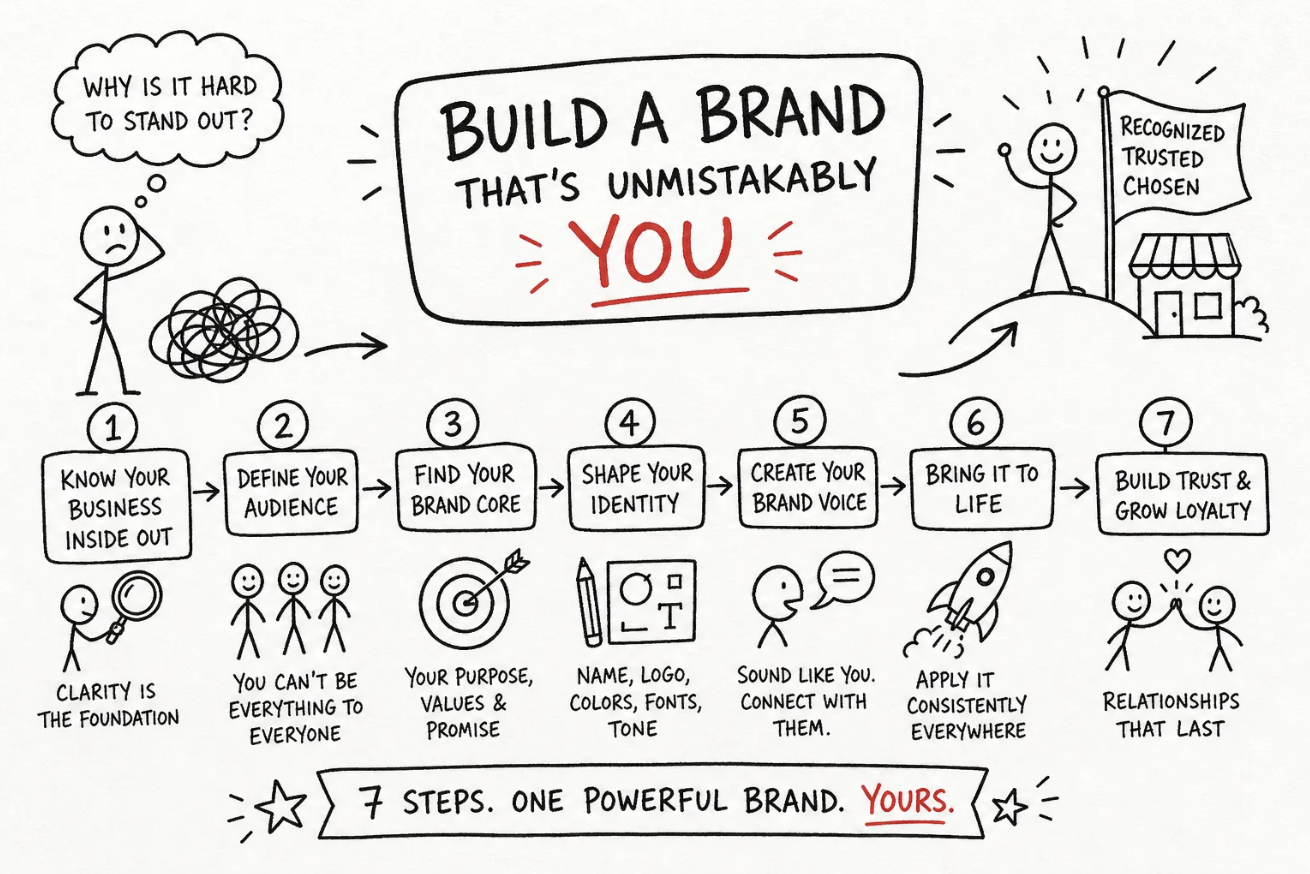
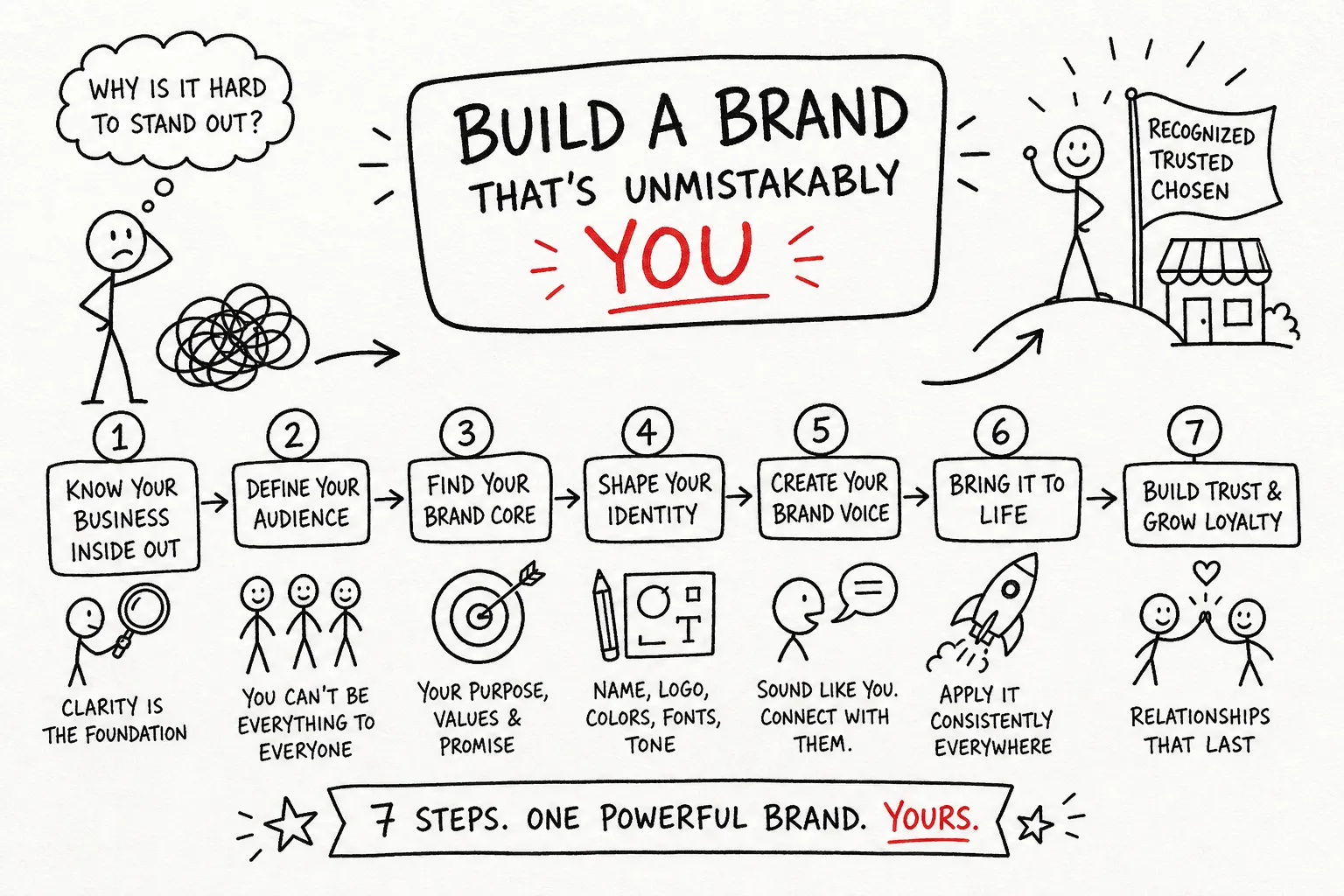
This article walks you through the exact 7-step system I use with clients, whether they're starting from scratch or untangling something that grew organically over the years. Follow these steps and you'll have a real, functional brand by the end.
What a brand identity for a small business actually includes
Here's the misconception that holds many businesses back: a logo is not a brand identity. It's one piece of the system, the visual anchor. Without the system around it, it just floats. Many small businesses pour money into a logo and then wonder why nothing feels cohesive. The logo isn't the problem. The missing system is.
A complete brand identity has two pillars: visual identity and verbal identity. Visual identity includes your logo system, color palette, typography, and imagery style. Verbal identity includes your brand voice, tone, and core messaging. Think of it like this: visual identity is what your business wears; verbal identity is how it speaks. The same person, different outfits and words, but always unmistakably themselves. Both pillars need to exist for a brand to feel real and recognizable.
The other thing that trips people up is the order. Strategy always comes before design. Many businesses skip straight to the visual stuff because it's more tangible and exciting. But when your visuals aren't grounded in clear strategy, they end up disconnected from what the business actually does and who it actually serves. That's why we start with the foundation.
Steps 1 and 2: Define your brand before you open Canva
Step 1: Clarify your positioning and audience
Step 1 is getting specific about who you're talking to and what you stand for. That means defining your target audience, your brand values, and your positioning in plain terms. A simple framing exercise: finish this sentence out loud. "We help [audience] who [specific problem] by [your solution]." If you stumble on that, you're not ready to design anything yet. That's okay. Many small businesses haven't done this work explicitly, even if they've been operating for years.
Step 2: Write your brand voice and core messages
Step 2 is writing your brand voice and core messages. Brand voice is the consistent personality your business uses in words: warm, direct, expert, playful, or some combination. Tone of voice is how that personality shifts by context. Your customer support email can sound slightly different from your Instagram caption while still feeling like the same brand. Pick three to five voice traits and define what each one means and what it doesn't mean. For example, "direct" means we get to the point quickly. It does not mean cold or abrupt. Then write five phrases your brand uses and five it avoids. That one exercise can significantly improve how your team writes and keeps your voice consistent over time.
Your core messaging layer ties this together: your value proposition, your tagline, and the two or three phrases your brand repeats across every channel. Consistent language builds trust, and it costs nothing but clarity.
Steps 3 through 5: Building your visual identity system
Step 3: Build a logo system, not just a logo
Step 3 is your logo. A complete logo system isn't just one file. It's your primary logo plus simple variants for different uses: a horizontal version, a stacked version, and an icon-only version. That way, the brand fits everywhere it needs to, from a banner to a profile photo, without looking forced or cropped awkwardly.
Step 4: Lock in your color palette and typography
Step 4 is your color palette and typography. Your palette should include a primary color, a secondary color, and one or two neutrals, each defined with an exact HEX code. Typography comes down to one or two typefaces with clear hierarchy rules: which font is for headings, which is for body text, and how they work together. Logo, colors, and typography are the non-negotiable core of your visual identity. Everything else builds on them.
Step 5: Define your imagery style
Step 5 is defining your imagery style. This is the element small businesses most often skip, and it's the reason a brand can have a great logo and still look inconsistent online. Imagery style means deciding what kinds of photos feel on-brand, what illustration or icon style you use, what feels completely off-brand, and what mood or visual treatment ties everything together. One or two clear rules here go a long way. A local contractor brand might define its imagery style as "real job site photography, natural lighting, no stock photos." That single rule eliminates hundreds of bad content decisions.
On budget: in 2026, DIY tools like Canva, Adobe Express, Coolors, and Inkscape run from free to about $250 per year. A freelancer package for logo plus a basic brand kit typically lands between $300 and $2,000. Small studios generally sit at $1,000 to $5,000 for more custom work. Knowing this helps you calibrate expectations and pick the right path for your stage of business.
Step 6: Assembling a brand style guide that people actually use
A brand style guide is the document that keeps your visual identity for your small business consistent across time, team members, and platforms. For most small businesses, a single well-organized page beats a 40-page PDF that no one opens. Done is better than perfect here, and a usable one-pager delivers more value than a comprehensive document collecting digital dust.
What to include in your brand kit for small business
Your one-page brand guide should include these sections:
- Brand overview: business name, short positioning statement, and who the brand is for
- Logo usage: primary logo, alternate versions, clear space rules, and usage examples showing what to do and what to avoid
- Color palette: two to four core colors with exact HEX codes
- Typography: heading font, body font, and hierarchy rules
- Imagery guidelines: photo mood, what's on-brand, what's off-brand
- Voice and tone: three to five descriptors with a brief "sounds like / doesn't sound like" note
For tools in 2026, the practical stack looks like this: Canva for template creation and brand kit storage, Coolors for generating your palette quickly, Inkscape for clean vector logo files and true brand ownership, Adobe Express for its strong free tier, and Brandmark.io for generating matching brand assets across social and print. For most small businesses, Canva combined with Coolors and Inkscape covers the full workflow at close to zero cost. If you want a fast, cohesive full brand kit with matching assets, Brandmark.io is worth exploring as a starting point.
Step 7: Getting your brand identity in front of people
Building a brand system that lives only in a Canva folder is not a brand. Consistency across touchpoints is what creates recognition, and recognition is what creates trust. In your first 30 days of launching or relaunching a brand, prioritize these: update your website header and about page, refresh all social media profile photos and bios, align your email signature and marketing templates, and update your business card or any printed materials. Those are the highest-visibility surfaces, and consistency there does more work than any ad campaign.
Beyond the basics, here are a few low-budget tactics that work in the real world. Add a logo sticker and a handwritten thank-you note to every order or delivery. Show up at local events with a simple branded banner, an inexpensive investment that makes a business look established immediately. Use social media to tell behind-the-scenes stories consistently rather than just posting products or promotions.
Build your email list early because email remains one of the highest-return, lowest-cost branding channels available. And create one shareable moment in your space or online, a photo-worthy display, a bold quote wall, a distinctive packaging detail, something people want to photograph and post. A dessert shop that builds a colorful photo corner near the pickup counter is doing smarter brand work than many businesses spending ten times more on ads.
DIY vs. hiring a pro: how to make the right call
DIY branding works when the business is new, the budget is tight, and the owner has the time and design sensibility to execute consistently. Canva and similar tools produce solid results, but they require discipline. The temptation to switch colors, try a new font, or grab a trendy template is real, and that's exactly how a brand slowly becomes inconsistent again over time.
When a business has revenue but still looks like a startup, when marketing feels scattered and nothing is converting, the problem usually isn't the tools. It's the strategy. That's the inflection point where working with a seasoned brand strategist makes more sense than buying another template or starting a new Canva project from scratch.
At Stellar Media Marketing, I work with businesses at exactly that stage. As a Fractional Social Media Director, I don't just hand over a brand kit and disappear. I take an active role in your brand's direction and execution, bringing director-level thinking to businesses that need results without the overhead of a full-time marketing hire. The outcome isn't just a prettier logo. It's a brand identity design that builds trust and supports measurable business growth.
Your next step starts with clarity
Here's the recap: start with strategy, build your verbal identity, create your visual system, document everything in a simple brand style guide, and apply it consistently everywhere your business shows up. That's the whole system, and it's what a strong brand identity for a small business actually looks like in practice. None of it requires a massive budget or a big agency. It requires clarity, consistency, and a commitment to following the steps in order.
If you've been piecing things together on your own and the brand still doesn't feel like it represents who you really are or the level you're playing at, that's not a Canva problem. That's a strategy problem, and it's exactly what I help businesses solve. Book a discovery call with Kelly Mirabella at Stellar Media Marketing and get a straight-talk assessment of where your small business brand identity actually stands and what it would take to build something that works as hard as you do.