

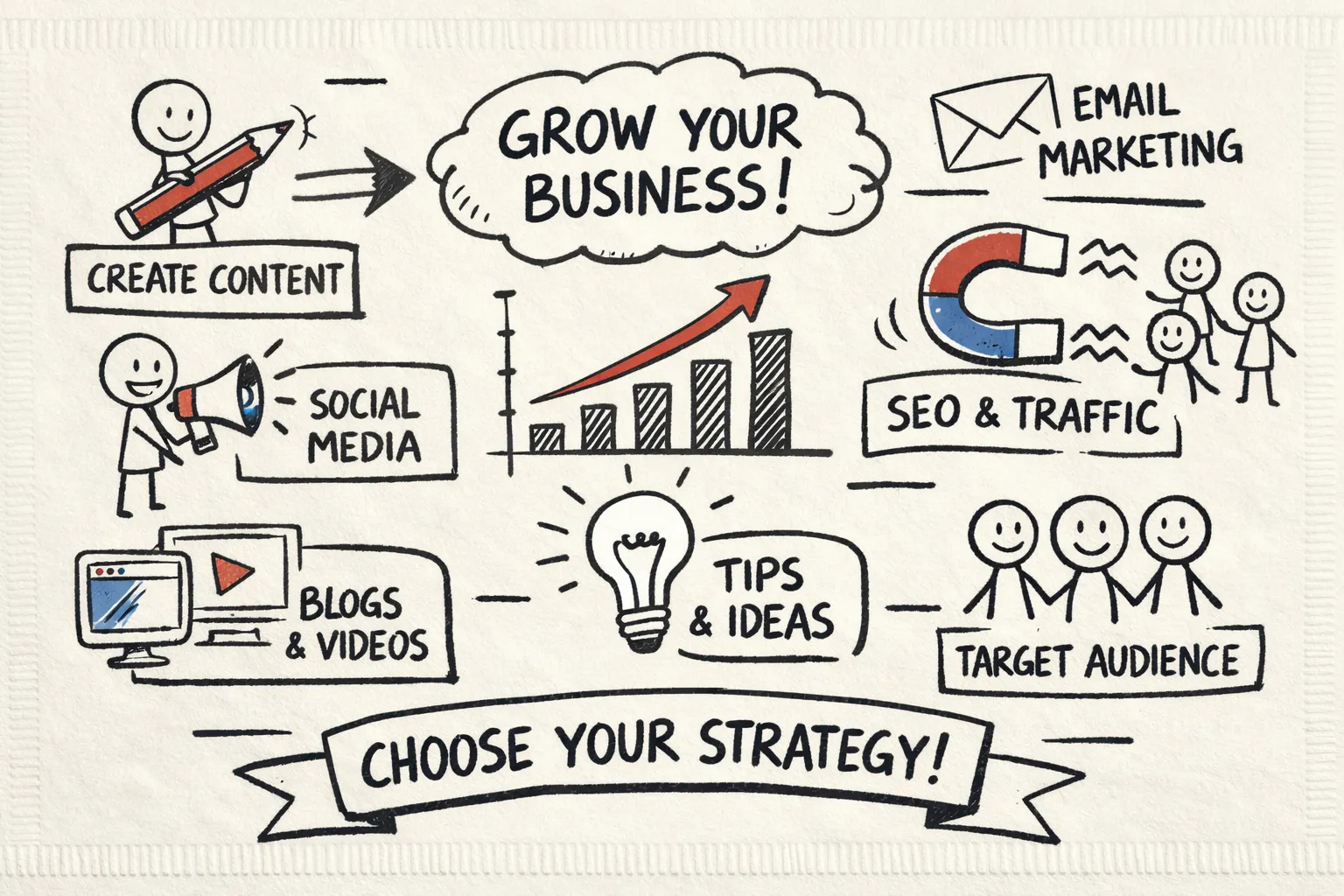
Small business owners know they need content marketing, but choosing the right content marketing options for small business is where most people get stuck. Every expert, platform, and trend pushes a different "best" channel, and the result is paralysis. You spend more time debating between blogging and TikTok than actually publishing anything. That indecision costs you more than a bad choice would.
The real issue isn't a shortage of options. It's the absence of a framework for choosing. Your small business content strategy should be downstream of your goals, your audience, and your actual capacity to execute, not based on what's trending or what your competitor posted last week. This article breaks down the most effective content marketing options for small businesses, from fully DIY approaches to done-for-you services, so you can build a shortlist that fits where you are right now.
By the end, you'll have a realistic view of costs and ROI timelines, a set of KPIs worth tracking, and a clear 30/90-day content plan for your small business to move forward. No vague advice about "posting consistently." Just a decision framework you can use today.
Why picking the right channel beats picking every channel
Most small business owners launch their content marketing by doing everything at once: a blog, Instagram, Facebook, a newsletter, maybe short-form video. Within two months, every channel is inconsistent, none of it is strategic, and the whole effort quietly gets abandoned. Diluted effort across five channels produces weaker results than focused effort on two. Small businesses that concentrate on one or two channels and execute consistently tend to see measurable results within 90 days. Scattered efforts rarely track to business outcomes at all.
Before choosing any channel, answer three questions: Who are you trying to reach? What do you want them to do next? How much time and money can you realistically commit each week? A local contractor trying to generate service calls needs a completely different content approach than a product-based business building national brand awareness. Your channel choices should follow from honest answers to those questions, not from what a social media guru recommended in a podcast ad.
The three content support tiers every small business should understand
Content marketing doesn't have a single price point or delivery model. It exists on a spectrum from fully self-directed to fully managed, and the right tier depends on your budget, your time, and how much of this you want to own personally.
Tier one: DIY with prompts and content calendars. This is where most small business owners start with low-budget content marketing. You use structured prompts, monthly topic guides, and simple content frameworks to direct what you post and publish. Costs stay low, often under $100 per month in tools, but you're committing roughly 5 to 10 hours per week of your own time. This tier works well for owners who enjoy talking about their business and have a clear picture of their audience. The non-negotiable is having a repeatable system so content creation doesn't become a weekly scramble.
Tier two: Template-based content that does the heavy lifting. The middle tier gives you pre-built structures for social posts, blog outlines, and email sequences. You customize them with your brand voice, offers, and specifics, but you're never starting from a blank page. This is where many growing businesses find the best balance between cost and output. You keep creative control while cutting production time significantly.
Tier three: Fully managed content creation. At this level, a team creates, edits, and publishes your content for you. For business owners whose time is worth more than the cost of outsourcing, this tier consistently delivers the strongest ROI because content gets produced, published, and tracked without depending on the owner's bandwidth.
At Stellar Media Marketing, content services are structured across exactly these three tiers so businesses at different stages get the support they actually need, rather than overpaying for deliverables they're not ready to use.
Content marketing options for small business: channel ROI and effort
Blogging and SEO content deliver the highest long-term ROI of any content channel for small businesses. Some B2B benchmarks cite returns as high as 748% over a sustained 12 to 24-month period, and small local service businesses regularly see 200 to 400% ROI once organic traffic compounds. The trade-off is time: expect 3 to 6 months before you see meaningful search traffic, and the content needs to be genuinely useful to rank. For local service businesses, pairing blog content with a Google Business Profile accelerates results, those visitors already have purchase intent. For a broader look at how different channels compare on ROI, see this digital marketing channels ROI comparison for helpful context.
Short-form video generates results faster than almost any other content format. Early engagement can climb quickly for businesses that publish consistently, though results vary by industry and audience. Costs range from zero if you're filming on your phone to $500 to $1,500 per professionally edited video. The catch is volume and consistency: organic video requires both to gain real traction, which is exactly where many small businesses stall out after an enthusiastic first week. If you're pricing out content production, this guide on how much to charge for social media content creation outlines common rates and deliverables creators use.
Email marketing is the most underrated channel on this list. You own the audience, which means no algorithm controls your reach. An email list is a direct line to people who asked to hear from you, and triggered sequences regularly generate three times the returns of standard batch sends. Open rates, click-throughs, and unsubscribes give you near-instant feedback on what's resonating. For small businesses with an existing customer base, this is one of the highest-leverage content marketing options available, and it's often the last one they prioritize.
What each content option actually costs in time and money
DIY content marketing looks free, but the math doesn't hold up under scrutiny. A small business owner spending eight hours per week on content is spending roughly $1,600 to $3,200 per month in opportunity cost, depending on what that time is actually worth. Add tools, stock images, and scheduling platforms, and the real monthly cost of DIY sits between $200 and $600 in cash plus significant time. That's not an argument against doing it yourself. It's an argument for being honest about what you're committing to before you start.
Freelance content creators charge between $20 and $150 per hour depending on experience, with mid-level specialists averaging $40 to $85 per hour. Agency packages for small businesses typically fall into three ranges:
- Basic packages ($500 to $1,500 per month): social management and light content creation, usually 2 to 3 platforms
- Standard packages ($1,500 to $4,000 per month): multi-platform management with video, 15 to 20 pieces of content monthly
- Premium packages ($4,000 to $10,000+ per month): comprehensive content creation, strategy, and paid media management
For most small businesses, the $1,500 to $3,000 range covers a solid, consistent content strategy with measurable deliverables. Done-for-you content packages from boutique agencies typically include a monthly content calendar, 1 to 2 blog posts, social media posts, an email newsletter, and a performance report. That's a full-stack approach without the overhead of a full-time hire.
KPIs to track and realistic timelines for each channel
In the first 30 days, you're not chasing revenue. You're establishing baselines. Track website traffic (total visits, new vs. returning), social media reach and engagement rate, and email open rates if you're running a newsletter. These early numbers tell you whether your content is reaching people at all and give you a benchmark to measure growth against. Limit yourself to 3 to 5 KPIs in this phase to avoid data overload.
By day 90, the metrics that matter shift from awareness to action. You're looking at:
- Lead generation: form fills, calls, and direct inquiries
- Time on page for blog content (above two minutes signals genuine interest)
- Email click-through rates and conversions from linked offers
- Social followers converting to website visitors (track via UTM parameters or a platform-specific landing page)
SEO results and organic blog traffic typically show measurable growth between months three and six. If you're running paid social alongside organic content, expect cost-per-lead data worth evaluating by the end of the first 90 days. The businesses that get surprised by poor results at the six-month mark are usually the ones who skipped the baseline-setting in month one.
Your 30/90-day small business content plan
Start by picking no more than two channels based on where your target audience actually spends time and what format you can realistically sustain. Set a publishing cadence you can keep, even if it's one blog post and four social posts per week. Use a simple content calendar to map topics two to three weeks ahead so you're never creating from scratch at the last minute. The goal in the first 30 days is not perfection, it's consistency and data collection.
Consider how Dollar Shave Club turned a single $4,500 video into 9.5 million views and 12,000 new customers in two days: one core asset, distributed intelligently. That "create once, distribute everywhere" principle applies at any budget. Once you have 30 days of published content, you have raw material to repurpose. A blog post becomes three social captions and an email newsletter. A short video gets its transcript turned into a blog introduction. This approach multiplies your output without multiplying your effort, and it's one of the most practical low-budget content marketing strategies available to small business owners. For practical techniques on how to repurpose content across formats and platforms, see this guide on repurposing content across platforms.
At the 60-day mark, review your KPIs and identify which content types and topics are driving the most engagement and leads. Double down on those. By day 90, you should have a clear picture of which channels are earning attention and which ones need to be adjusted or dropped entirely. That data is more valuable than any trend report or competitor analysis you'll find online. If you want a planning framework to map 30/90/365 milestones and tactics, this 90-180-365 content marketing plan walks through common cadences and checkpoints.
Build on what works, not on what's popular
The right content marketing options for your small business aren't the ones trending on LinkedIn or the ones your competitors are using. They're the ones aligned with your goals, your audience, and your actual capacity to execute. Whether you're building a DIY system using prompts and templates or working with an agency that handles creation end to end, the framework is the same: pick channels strategically, set honest budgets, track meaningful KPIs, and give your efforts enough time to produce real data.
Content marketing compounds. The businesses that see the biggest results aren't the ones who did the most. They're the ones who did the right things consistently over time. Start with two channels, follow the 30/90-day plan, and adjust from there. That's a small business content strategy worth building on.
If you're not sure which content marketing options fit your business or which tier of support makes sense for where you are right now, the team at Stellar Media Marketing offers a foundation-first audit that gives you a clear picture of what's working, what isn't, and exactly where to focus next. Start there and build from a position of clarity, not guesswork.