

Last updated: September 2026 · By Kelly Noble Mirabella, Fractional Social Media Director and Founder of Stellar Media Marketing (Aurora, CO)
Quick answer: To get mentioned in AI answers, publish genuinely useful content that answers real questions, front-load a direct answer near the top, cite credible sources by name, and earn mentions across the web. Google's May 2026 guidance is blunt about it: "optimizing for generative AI search is optimizing for the search experience, and thus still SEO."
I've been writing my own blog posts with this approach for about three or four months. My traffic is up significantly, and my listings in search results have increased. My name also comes up in AI tools when people ask about chatbot marketing, which is the clearest proof I have that this works.
Do you need a separate strategy for AI search?
No. You need better SEO, done with AI answers in mind. Google published official guidance on optimizing for generative AI features in May 2026, and it treats AEO and GEO as part of SEO, not a separate discipline.
Two mechanics are worth understanding:
- Grounding. Google's AI features use retrieval-augmented generation. The search systems retrieve relevant pages from the index, and the model uses those pages to build the answer, with clickable links to sources.
- Query fan-out. The system generates related follow-up queries behind the scenes. Ask about fixing a weedy lawn and it also searches things like removing weeds without chemicals. That's why answering the neighboring questions on your page matters.
What actually gets content cited by AI?
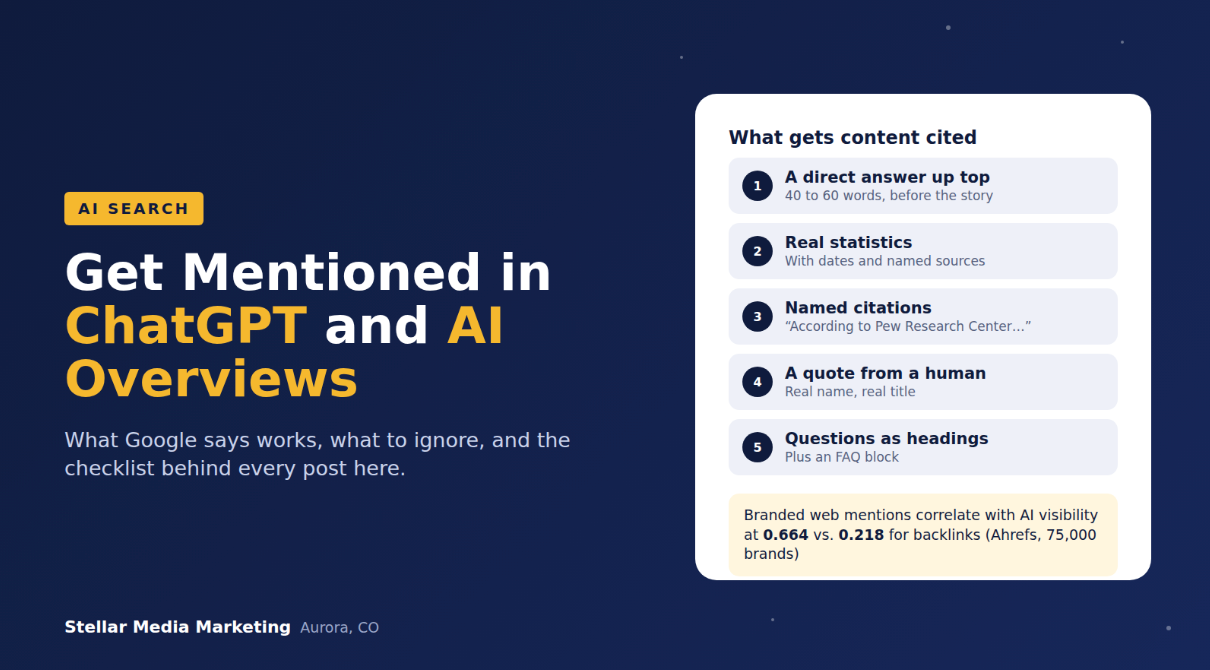
Research points to four things: a clear answer near the top, real statistics, named citations, and quotes from real people.
The Princeton-led study "GEO: Generative Engine Optimization" (Aggarwal et al., KDD 2024) tested optimization tactics across a 10,000-query benchmark. Adding citations, statistics, and quotations each lifted visibility in generative answers by roughly 30 to 40 percent, while keyword stuffing and padding did nothing or backfired. The researchers also found that lower-ranked sites gained more than already-dominant ones, which is good news if you're a small business competing with national publishers.
Here's how that translates into writing:
- Direct answer up top. What it looks like on the page: A 40 to 60 word answer right under the headline, before any story.
- Statistics. What it looks like on the page: Real numbers with dates and sources, not "studies show".
- Named citations. What it looks like on the page: "According to Pew Research Center" in the sentence, not just a link.
- Quotes. What it looks like on the page: A real quote from a named person with a title.
- Question headings. What it looks like on the page: Headings written the way people ask, not one-word labels.
- An FAQ block. What it looks like on the page: Five or more real questions, which also catches fan-out queries.
What can you ignore?
Skip the tricks being sold as AI optimization. Google's own guidance says you don't need:
- llms.txt files. Google Search doesn't use them.
- Content "chunking." There's no requirement to break content into tiny pieces for AI.
- AI-specific rewriting. You don't need to write in a special way just for generative search.
- Bought or manufactured mentions. Google explicitly says chasing inauthentic mentions isn't effective.
"Every few months someone sells business owners a new file to upload or a new format to chase. Google keeps saying the same thing: be the best answer to a real question. That's the whole trick, and it's the hard part." Kelly Noble Mirabella, Fractional Social Media Director and Founder, Stellar Media Marketing
Why do brand mentions matter more than backlinks now?
Because AI systems appear to favor brands that get talked about, not just linked to. Ahrefs studied 75,000 brands and measured which signals correlate with appearing in Google's AI Overviews:
- Branded web mentions: 0.664
- Branded anchor text: 0.527
- Branded search volume: 0.392
- Backlinks: 0.218
Ahrefs also found brands in the top quarter for web mentions averaged 169 AI mentions, about ten times the next quartile. Importantly, the researchers note correlation is not causation, so treat mentions as something to earn rather than a guaranteed lever.
Practically, that means podcasts, guest articles, local press, YouTube, industry roundups, and being quoted by other people all feed the same machine.
A practical checklist for your next blog post
Use this on every post. It's the same structure I use on mine.
- Write the title as the question someone actually asks.
- Answer it in 40 to 60 words at the very top, with a specific number or named entity.
- Use question-style headings, and answer each one in the first sentence beneath it.
- Add real statistics with the source named in the sentence.
- Quote a real person with their name and title.
- Add a comparison table or numbered steps, the formats AI tools lift most easily.
- Close with an FAQ of five or more real questions.
- Show the date and refresh the post on a schedule.
- Earn mentions off your site through interviews, partnerships, and video.
That last one matters more than most small businesses think. Since AI tools weigh what the wider web says about you, showing up on other people's platforms compounds.
How do you know if it's working?
Watch three things:
- Search Console. Google added a generative AI performance report, which is the only first-party view of AI Overview activity. Be skeptical of third-party tools claiming access to internal AI metrics.
- Ask the tools directly. Every month, ask ChatGPT, Perplexity, and Google AI Mode the questions your customers ask. See whether you appear.
- Watch traffic and rankings. Mine improved within a few months of writing this way, and the posts that rank are also the posts that get quoted.
For the local version of this, see how to use Google Business Profile posts and what social media metrics to actually track.
Want someone to run this for your business? I'm a fractional social media director in Aurora, Colorado. See my services or book a discovery call.
Frequently asked questions
What is generative engine optimization (GEO)?
GEO is the practice of making content more likely to be used and cited in AI-generated answers. Google considers it part of SEO, since its AI features run on the same core ranking systems.
How long does it take to show up in AI answers?
There's no fixed timeline. In my own case, writing this way for three to four months produced a significant traffic increase and more search listings. Expect months, not days.
Does ChatGPT use the same sources as Google?
Not entirely. ChatGPT blends training data with selective web retrieval, Google grounds answers in its search index, and Perplexity runs a live search on nearly every query and leans hard on fresh content. Overlap between them is limited, so publish for humans first and structure for extraction second.
Do I need schema markup to appear in AI Overviews?
Google says structured data isn't required for generative AI features. It's still worth having for rich results in regular search.
Should I publish an llms.txt file?
Google says it doesn't use them. It won't hurt to publish one, but don't treat it as a strategy or pay someone to sell you one.
How often should I update my blog posts?
Quarterly for your most important pages. Freshness matters most to tools that search the live web on every query, and re-timestamping alone isn't enough. Update the numbers and examples.
Changelog: September 2026, first published.