

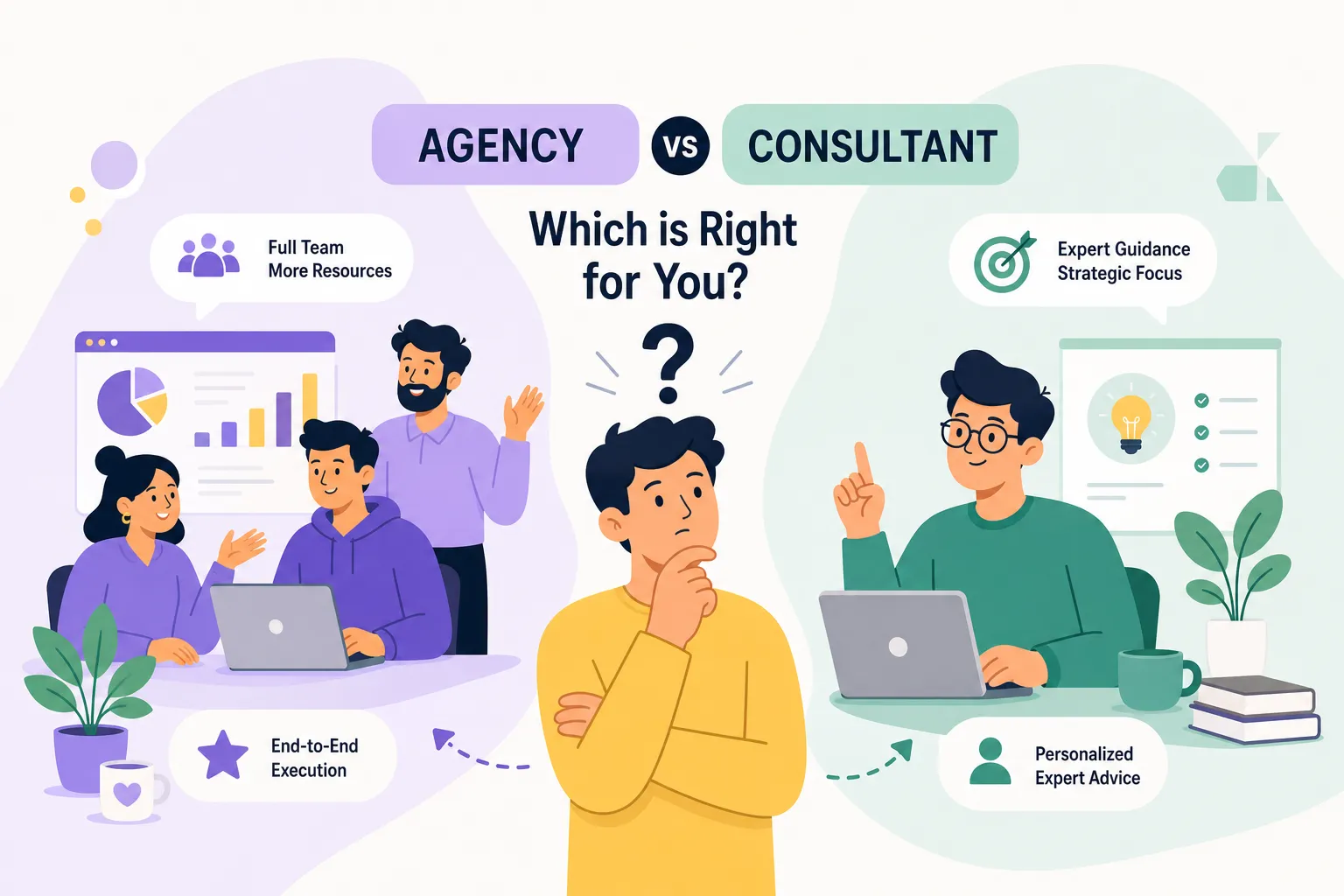
You just got off two back-to-back sales calls. One was with a polished agency that talked about "full-funnel ecosystems" and showed you a beautiful case study deck. The other was with a marketing consultant who said all the right things about strategy, positioning, and brand clarity. Both promised results. Neither actually explained what they'd do on a Tuesday morning for your business. Now you're sitting there more confused than when you started.
The marketing agency vs consultant question trips up even experienced founders, and that confusion is completely normal. In my experience, many business owners are genuinely unclear about what they're buying when they hire a marketing agency versus a consultant. The terminology overlaps, the proposals look similar, and the pricing varies wildly. Choosing wrong doesn't just cost money; it costs months of momentum you can't get back.
Here's what I've learned from spending 18 years working on both sides of this equation: as the person building strategy and the person executing it, I've seen exactly where each model shines and where it falls apart. There's also a third option most business owners never hear about until they're already frustrated with the first two. We'll get to that. But first, here's exactly what you're buying with each model.
What you're actually buying: agency, consultant, or fractional director
Most comparison articles treat this as a simple either/or. It's not. There are three distinct models, and they serve very different needs.
The agency model: a team built for execution
When you hire a full-service marketing agency, you're buying capacity and coverage: copywriters, designers, media buyers, project managers, and analysts working under one roof on your behalf. That's the core value proposition. Agencies shine when you already have a clear strategy and need consistent, multi-channel execution delivered without having to manage a dozen freelancers yourself. What you're paying for is output volume, specialist labor, and the infrastructure to keep it all moving. Many agencies also contribute to strategy in full-service engagements, but their core strength is execution at scale.
The consultant model: strategy, diagnosis, and direction
An independent marketing consultant sells thinking, not doing. They're strongest when you need someone to diagnose what's broken, set clear priorities, define your positioning, or map out a go-to-market direction. Where consultants get weaker is in the day-to-day: ongoing content production, platform management, and consistent execution aren't what you're hiring them for. Most consultant engagements are either a defined project scope or a retainer that gives you advisory access on an ongoing basis.
Where the fractional director changes the equation
A fractional director is neither of those things exactly. This model combines senior-level strategic ownership with active execution leadership. You're not just getting advice and a deck. You're not just getting content published on a schedule. You're getting full accountability for your digital outcomes, from direction-setting through to weekly workflow management, as if this person were embedded in your business as a marketing leader. At Stellar Media Marketing, this is the model I operate from: strategic alignment and audience clarity before a single post is created, with phased execution tied to actual business goals. For small businesses that need real leadership without a six-figure salary, it's a fundamentally different option than the other two.
Marketing agency vs consultant: when the agency is the smarter hire
Agencies are absolutely the right call in specific situations, and knowing when that is will save you a lot of frustration.
You have strategic clarity but need execution bandwidth
The agency model works best when your business already knows what it wants done. Think: an established brand with clear positioning, an existing content calendar, and someone internal who can brief the agency team and review outputs. If you can hand over a strong brief and evaluate the work coming back, agencies are incredibly efficient. Agency onboarding typically takes two to six weeks, with campaign launches averaging four to eight weeks for most digital work and twelve to sixteen weeks for integrated campaigns across multiple channels.
You need multi-channel coverage no single person can handle
Agencies bring a full bench. Under one contract, you can get SEO, paid media, social, email, and creative handled by specialists in each area. That makes sense when your audience lives on multiple platforms and you're past the "pick one channel and nail it" stage. The trade-off is real, though: you'll pay for that entire bench even during months when you only need part of it. Agency retainers in 2026 typically run $3,000 to $15,000 per month, with higher-end full-service engagements reaching $10,000 to $20,000 or more monthly. That's a meaningful investment, and it only makes sense when you have the strategy and internal capacity to get value from every piece of it.
Marketing agency vs consultant: when a consultant or fractional director wins
This is where the agency vs consultant conversation gets more nuanced, and where I see the most expensive mistakes happen.
Your strategy is stalled, not just your execution
The most common and costly mistake small business owners make is throwing execution resources at a broken strategy. One situation I worked through: a business had used an agency for three years, plateaued, and couldn't figure out why. An independent audit found the strategy was never updated as the business evolved. After a strategic refresh with the same execution team, lead volume jumped significantly within six months. In another engagement, a multi-location business was running three agencies across different channels with no unified direction. Consolidating the strategy and cutting two agencies reduced spend substantially while increasing qualified leads in just four months. The signal to watch for: you're producing content consistently but it's not building trust, generating leads, or converting anyone. That's a strategy problem, not a production problem.
You need senior-level thinking without senior-level headcount
Independent consultants typically get started within 48 hours to one week, far faster than agency onboarding. For businesses in transition, early growth, or a post-plateau reset, a consultant or fractional director can deliver a clear roadmap before a single execution dollar is spent. Consultant retainers run $1,500 to $15,000 or more per month, and senior fractional director support can reach $5,000 to $20,000 monthly. The nuance matters: you're buying strategy and direction, not just deliverables. That's a very different value exchange than paying an agency to publish content.
Agency retainer vs consultant hourly: what the real cost breakdown looks like
Vague ranges don't help you make a decision, so here are actual numbers.
What agencies actually charge in 2026
For execution-level work, agencies often price around $25 to $49 per hour. When strategy is included, that range moves to $100 to $175 per hour. Project-based digital marketing work commonly falls in the $10,000 to $49,999 range. Monthly retainers sit at $3,000 to $15,000 for mid-range agencies, and $10,000 to $20,000 or more for comprehensive, full-service engagements. What drives the cost up is the number of channels you need covered, creative volume, and whether strategy is included in the scope or assumed to already exist.
What consultants and fractional directors charge
Independent consultants typically charge $75 to $250 per hour for advisory work, with senior fractional leadership reaching $500 or more per hour. Project-based consultant engagements run $2,000 to $50,000 or more depending on scope. Monthly retainers range from $1,500 to $15,000 for independent consultants, with senior fractional director engagements commonly falling between $5,000 and $20,000 per month. The key nuance: consultants cost more per hour, but often cost less overall because you're buying one expert's focused attention, not an entire team's operational overhead.
The hidden cost most business owners miss
Choosing the wrong model doesn't just drain your budget; it drains your calendar. An agency without a strategy brief produces busy work that looks productive and delivers nothing. A consultant without execution support produces a beautiful roadmap that sits in a Google Drive folder untouched. The real question isn't "which is cheaper?" It's: what does your business actually need right now, direction, delivery, or both?
Marketing firm vs independent consultant: the option many business owners discover too late
This is the option that rarely comes up in those two sales calls you sat through, because neither side has an incentive to mention it.
What a fractional social media director actually does
A fractional director takes full ownership of your digital strategy and execution. Not just a slice of one or the other: full accountability for direction, workflow, consistency, and outcomes, as if it were their own brand on the line. Unlike an agency that executes on request, a fractional director sets the direction, builds the systems, manages the process, and measures what matters. At Stellar Media Marketing, this is exactly how I work with clients: starting with strategic alignment and audience clarity, moving through brand authority building, and into full-service execution in a phased process where goals come first and content comes second. This model makes sense when you've outgrown doing it yourself but aren't ready to hand $15,000 a month to an agency team you'll rarely speak to directly.
Who this model is built for
The fractional director model fits businesses at a specific inflection point. You're generating real revenue but still running your own social media out of habit or budget caution. You want someone to take the wheel entirely, not just hand you a strategy PDF and wish you luck. You need executive-level thinking applied consistently as an ongoing operating function, not as a quarterly check-in. The Stellar Media Marketing model scales from strategy-only consulting through to full done-for-you management, with training built in for internal teams where that makes sense. It's structured to grow with you, not lock you into a scope that made sense six months ago.
Questions to ask and KPIs to require before you sign anything
Whether you're evaluating an agency, a consultant, or a fractional director, the right questions reveal whether this partnership is built to deliver results or built to deliver invoices.
Questions that reveal whether you have the right fit
- Can you walk me through a client with a similar business situation? What did you actually do, and what specifically changed for them?
- Who will be working on my account week-to-week, and will I have direct access to that person?
- What does onboarding look like, and how long before results are realistically measurable?
- If the strategy isn't working after three months, how do you handle that? Do you adapt, or do you keep executing against a locked scope?
KPIs and contract terms to insist on
For retainer contracts, define response time, reporting cadence, the number of advisory hours or deliverables included, and a clear escalation path if expectations aren't being met. For project contracts, structure payments around accepted milestones, not just calendar dates. For any engagement, require a baseline measurement before the work begins, set near-term targets (around month three) and mid-term targets (around month six) based on your specific goals, and get a written definition of what success looks like for your business. Key metrics worth tracking include engagement rate, website traffic from social, and lead volume, though which metric matters most depends on your business stage. Early-stage businesses typically prioritize traffic and engagement, while growth-stage businesses should weight lead volume and conversion rate most heavily. Red flag to watch for: any provider who can't name a specific baseline metric or who avoids putting KPIs in writing. That's not modesty. That's a warning sign.
The right choice depends on where you actually are right now
The marketing agency vs consultant question doesn't have a universal answer. It has a "right now" answer that depends on your business stage, your internal capacity, and whether your biggest gap is direction or delivery.
If you have strategic clarity and need execution bandwidth across multiple channels, a full-service agency is probably your best next move. If your strategy has stalled, your content isn't converting, or you've never had someone own your marketing with real accountability, a consultant or fractional director will give you far more leverage per dollar spent. And if you need both strategic leadership and execution without a bloated agency retainer, the fractional director model is worth a serious look before you sign anything else.
At Stellar Media Marketing, I work with small business owners who are done guessing and ready to build something that actually works. Still weighing the marketing agency vs consultant decision for your specific situation? Book a discovery call and we'll map out exactly what your business needs right now, or start with a social media audit to see where the real gaps are before spending another dollar on execution.