
Last updated: September 2026 · By Kelly Noble Mirabella, Fractional Social Media Director and Founder of Stellar Media Marketing (Aurora, CO)
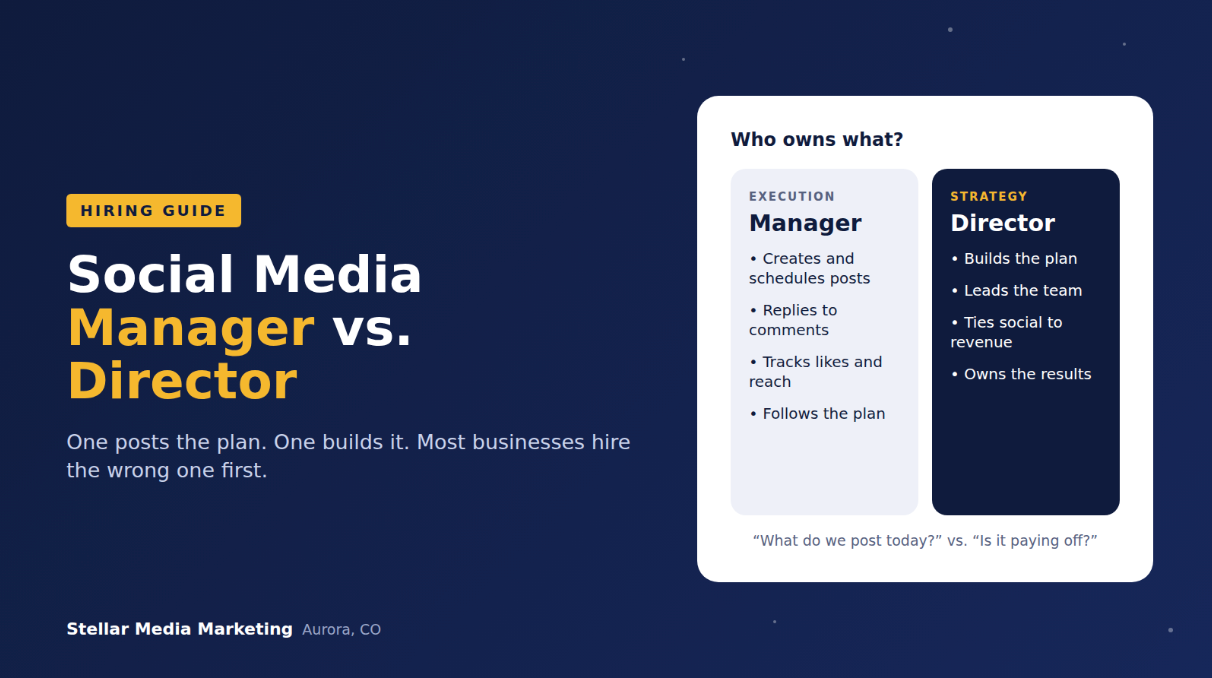
Quick answer: A social media manager executes a plan: creating, scheduling, and posting content and replying to comments. A social media director builds the plan, leads the people executing it, and connects social media to revenue. If nobody at your business owns strategy, you need a director first, even a part-time one, before another manager.
Most businesses hire the wrong one. Here's how to tell the difference and what to do if you already made the mistake.
What does a social media manager do?
A social media manager runs the day-to-day work of your social accounts. They turn a plan into posts and keep your pages active and responsive.
Typical responsibilities include:
- Creating or editing graphics, captions, and short videos
- Scheduling and publishing posts
- Replying to comments and messages
- Tracking basic metrics like reach, engagement, and follower growth
- Coordinating with photographers, videographers, or your team for content
That's valuable work. With 71% of U.S. adults using Facebook and 50% using Instagram, according to Pew Research Center's 2025 survey, your pages need someone keeping them alive. But a manager needs a plan to execute. Without one, they're guessing.
What does a social media director do?
A social media director is responsible for whether social media works, not just whether it gets done. They decide the direction and hold the work accountable to business goals.
A director:
- Sets the strategy: which platforms, which audiences, which messages, and why
- Builds the calendar around your business: launches, seasonality, sales priorities
- Leads the team: managers, freelancers, creators, and agencies
- Sets the standard: brand voice, quality, and approval process
- Reports in business terms: leads, booked calls, sales influenced, and cost per result
- Advises leadership: on ads, AI tools, crisis response, and where to invest next
For most small and mid-sized businesses, this role is a fractional social media director: a senior person you hire part time.
Manager vs. director: side-by-side comparison
The simplest way to separate the roles: the manager answers "what are we posting today?" The director answers "what should we be posting, for whom, and is it paying off?"
- Core focus. Social media manager: Execution. Social media director: Strategy and leadership.
- Owns. Social media manager: The calendar and the posting. Social media director: The plan, the team, and the results.
- Typical experience. Social media manager: 1 to 5 years. Social media director: 10+ years.
- Measures. Social media manager: Reach, engagement, followers. Social media director: Leads, sales, cost per result, plus reach and engagement.
- Decides what to post? Social media manager: Follows the plan. Social media director: Builds the plan.
- Handles a PR problem? Social media manager: Flags it. Social media director: Leads the response.
- Full-time pay reference. Social media manager: BLS median for marketing specialists: $78,760 (2025). Social media director: BLS median for marketing managers: $166,790 (May 2025).
- Part-time option. Social media manager: Freelance or agency. Social media director: Fractional director.
Pay references from the U.S. Bureau of Labor Statistics for market research analysts and marketing specialists and marketing managers. BLS doesn't track social media roles separately, so these are the closest categories.
What happens when you hire a manager but need a director?
You get a busy feed and no business results. It's a common story, and it usually sounds like this: "We hired a social media person, they posted every day, and nothing happened."
That's not always the hire's fault. You asked a junior or mid-level person to do senior work: figure out the audience, the messaging, the platforms, and the goals, all while producing content every day. Most can't, because nobody taught them how.
Here's how it tends to show up:
- Posting is consistent, but nothing converts. Lots of activity, no calls or form fills.
- Reports are all vanity metrics. Likes and followers, with no connection to sales. (Here's which social media metrics to actually track.)
- Content drifts off-brand. The voice changes depending on who's posting and what's trending.
- Your manager keeps asking you what to post. Which means you're the strategist now, whether you wanted the job or not.
- Turnover resets everything. When the manager leaves, the strategy leaves with them, because it lived in their head.
In my audits, the pattern is clear. Of the last 20 free social media audits I ran, nearly 60% found generic or ineffective content. Those businesses weren't short on effort. They were short on direction.
"You don't fix a strategy problem by hiring a better poster. Put a director over the work, and suddenly the manager you already have starts looking like a much better hire." Kelly Noble Mirabella, Fractional Social Media Director and Founder, Stellar Media Marketing
Which one does your business need?
Use this decision guide:
- If you have a documented strategy and just need consistent execution, hire a social media manager.
- If you have someone posting but no strategy, no reporting, or no results, add a fractional director to lead them.
- If you have no one and no strategy, start with a director to build the plan, then hire or outsource execution. (Here's how to outsource social media the right way.)
- If you're a larger company with a full team, you may need a full-time director. A fractional one can bridge the gap while you hire.
One more option: a director who also does the work. That's how I work. I handle it all, from strategy to content creation, posting, and reporting, and most of my clients stay with me for two years or more. For example, a North Texas outdoor kitchen builder I work with doubled its Facebook views to 212,000 in 2025 (up 100.9% from 2024) and grew engagement 51%, with strategy and production under one roof.
Not sure which fits? See my services or book a discovery call and I'll tell you honestly, even if the answer is "you need a manager, not me."
Frequently asked questions
Is a social media strategist the same as a social media director?
They overlap. A strategist builds the plan, but may not lead a team or own results. A director does both: builds the strategy and is accountable for the people and outcomes.
Can a social media manager grow into a director?
Yes, with time and mentorship. Many directors started as managers. Pairing your manager with a fractional director is one of the fastest ways to develop them.
Do small businesses need a social media director?
Not all of them. Very small or early-stage businesses often need consistent execution first. Once you're established and spending real money on social, strategy becomes the bottleneck, and that's when a director pays off.
How much does a social media director cost?
A full-time director is a senior salary plus benefits. A fractional director costs a monthly retainer. I break down the numbers in How Much Does a Fractional Social Media Director Cost in 2026?
What should a social media director report on each month?
Business outcomes first: leads, inquiries, sales influenced, and cost per result. Then the supporting metrics: reach, engagement, views, and top-performing content, with a clear plan for the next month.
Can one person be both manager and director?
Yes, especially at smaller businesses. Just make sure the strategy work actually gets time. When one person does both, daily posting tends to crowd out planning.
Changelog: September 2026, first published.