

Last updated: September 2026 · By Kelly Noble Mirabella, Fractional Social Media Director and Founder of Stellar Media Marketing (Aurora, CO)
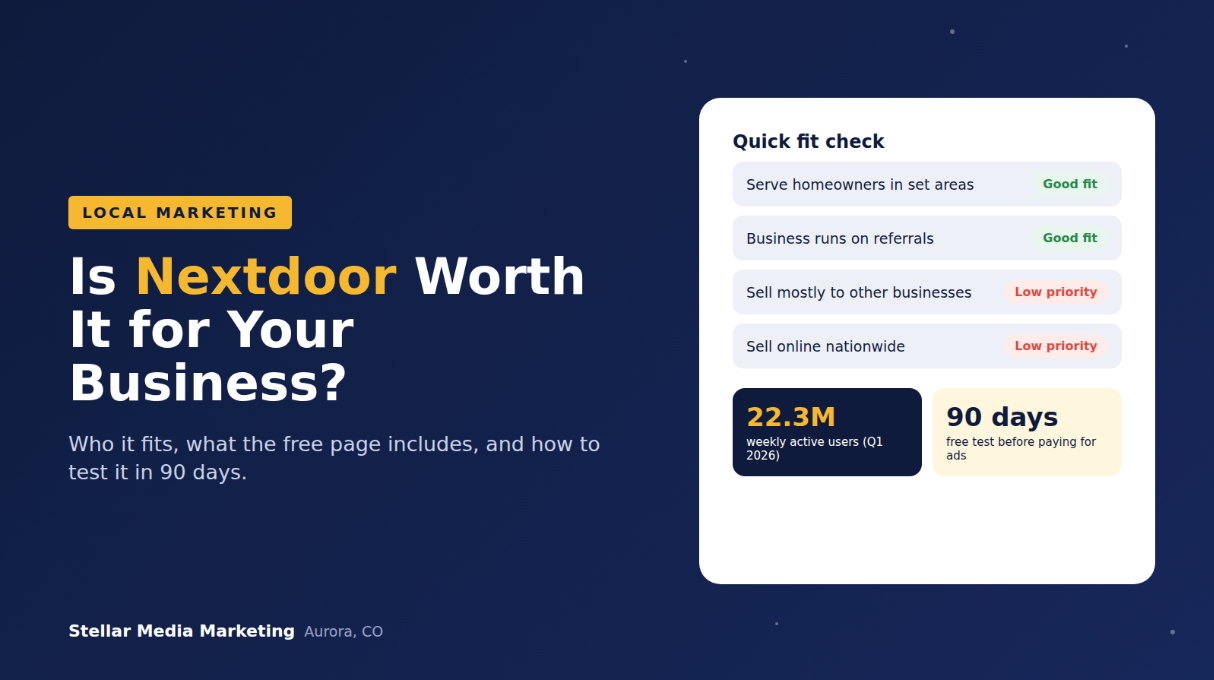
Quick answer: Nextdoor can be worth it for Denver-area businesses that serve homeowners in specific neighborhoods, because a Business Page is free and Nextdoor reports more than 110 million verified neighbors and 22.3 million weekly active users (Q1 2026). Treat it as a 90-day test: claim the free page, post weekly, and track inquiries before paying for ads.
That's the honest answer. Nextdoor isn't part of my standard client strategy, and I haven't managed it for clients, so I'm not going to pretend I have a hot take. What I can give you is the same framework I use to evaluate any platform.
What is Nextdoor, and how do businesses use it?
Nextdoor is a neighborhood-based social network where verified residents talk about local news, recommendations, and services. Businesses can join with a free Business Page and reach the neighborhoods around them.
According to Nextdoor's Business Page overview, a free page lets you:
- Publish unlimited free posts, like updates and expert advice
- Collect recommendations and "Faves" from neighbors
- Message directly with customers
- Share your contact info, photos, and story
- Create Local Deals
Nextdoor also sells paid advertising through its Ads Manager, which is separate from the free page.
How big is Nextdoor compared with other platforms?
Nextdoor is smaller than the major platforms but more focused on neighborhoods. In its first quarter 2026 results, Nextdoor reported 22.3 million weekly active users and more than 110 million verified neighbors.
For comparison, Pew Research Center's 2025 survey found 71% of U.S. adults use Facebook and 50% use Instagram.
- Google Business Profile. What it's best at for local businesses: Getting found by people ready to hire. Cost to start: Free.
- Facebook. What it's best at for local businesses: Broad local reach, community groups, reviews. Cost to start: Free (ads optional).
- Instagram. What it's best at for local businesses: Visual proof of your work. Cost to start: Free (ads optional).
- Nextdoor. What it's best at for local businesses: Neighborhood word of mouth and recommendations. Cost to start: Free (ads optional).
If you haven't nailed your Google Business Profile yet, start there. It's where customers searching for your service find you first. (Here's how to use Google Business Profile posts.)
Which Denver-area businesses are the best fit for Nextdoor?
Nextdoor tends to fit businesses whose customers choose based on neighborhood trust and word of mouth. Use these if/then checks:
- If you serve homeowners within a defined area (Aurora, Centennial, Parker, Southlands), Nextdoor's neighborhood focus lines up with your market.
- If your business runs on referrals, recommendations and Faves may extend that word of mouth online.
- If you sell mostly to other businesses, Nextdoor is probably not your first priority. LinkedIn is usually a better fit.
- If you sell online nationwide, a neighborhood network won't match your audience.
- If you can't commit to replying to messages quickly, wait. A slow response on any platform can cost you the job.
Home services, pet care, cleaning, landscaping, tutoring, and neighborhood restaurants are the kinds of businesses that often come up in neighborhood recommendation threads.
"Every platform is worth it right up until your customers aren't there. Don't join Nextdoor because someone told you to. Join it for 90 days, track what comes in, and let the numbers decide." Kelly Noble Mirabella, Fractional Social Media Director and Founder, Stellar Media Marketing
How do you test Nextdoor in 90 days?
Run Nextdoor as an experiment, not a commitment. Here's a simple test plan:
- Claim your free Business Page. Fill out every field, add real photos, and describe your service area clearly.
- Ask happy customers for recommendations. Nextdoor has its own guide to getting recommendations and Faves.
- Post once a week. Share helpful tips, recent local projects, and seasonal reminders, the same kind of content that works on Google.
- Reply to every message within a business day. Faster is better.
- Track every inquiry. Ask new customers "How did you hear about us?" and note which ones mention Nextdoor.
- Hold off on ads. Only test paid ads after the free page shows signs of life.
- Review at day 90. Compare inquiries, booked jobs, and time spent against your other channels.
If Nextdoor produced booked jobs for a reasonable amount of time, keep going. If it produced nothing, move that time back to the channels that work. You can learn more about measuring results in What Social Media Metrics Should You Actually Track?
What are the risks of marketing on Nextdoor?
Every platform has tradeoffs. Before you start, know these:
- Time. Free doesn't mean effortless. Posting and replying take real hours.
- Public feedback. Neighbors talk openly, which is great when they love you and uncomfortable when they don't. Have a plan for responding professionally.
- Spreading yourself thin. In the last 20 free social media audits I ran for Colorado businesses, 18 had a stale Google Business Profile and nearly 60% had generic or ineffective content. Adding another platform won't fix those problems. Fixing the basics first usually pays off more.
Want help deciding where to spend your time?
Choosing the right platforms is one of the first things I do with new clients. If you're in the Denver metro, local clients get special pricing on content days and packages. Contact me for details, see my services, or book a discovery call.
More local reading: Local Business Content Marketing: A Playbook That Works and 5 Content Types Local Businesses Need to Attract Customers.
Frequently asked questions
Is a Nextdoor Business Page free?
Yes. Nextdoor says its Business Page is free and includes unlimited free posts, recommendations, messaging, and business details. Paid advertising is a separate product.
How many people use Nextdoor?
Nextdoor reported 22.3 million weekly active users and more than 110 million verified neighbors in its first quarter 2026 results.
Is Nextdoor better than Facebook for local businesses?
They do different jobs. Facebook has a much larger audience, with 71% of U.S. adults using it according to Pew Research Center. Nextdoor is smaller but focused on neighborhoods and recommendations. Many local businesses use both.
Should I pay for Nextdoor ads?
Test the free Business Page first. If it produces inquiries and you can respond quickly, a small paid test can make sense. Track booked jobs, not just clicks.
What should a business post on Nextdoor?
Helpful, neighborly content: seasonal tips, recent local projects, answers to common questions, and occasional local offers. Keep it useful rather than salesy.
How long should I test Nextdoor before deciding?
Give it about 90 days with consistent weekly posting and fast replies. That's enough time to see whether it's producing real inquiries.
Changelog: September 2026, first published.