

Last updated: September 2026 · By Kelly Noble Mirabella, Fractional Social Media Director and Founder of Stellar Media Marketing (Aurora, CO)
Quick answer: Use AI for research, brainstorming, first drafts, repurposing, and SEO work. Never hand it your full strategy, a crisis, or posting without human review. Strategy is where AI gets convoluted, and social media is human communication, not a formula. Google's May 2026 guidance says the same about content: unique, useful, and genuinely expert still wins.
I use AI every single day in my business. I also have hard lines. Here's where each one falls.
What should you automate with AI?
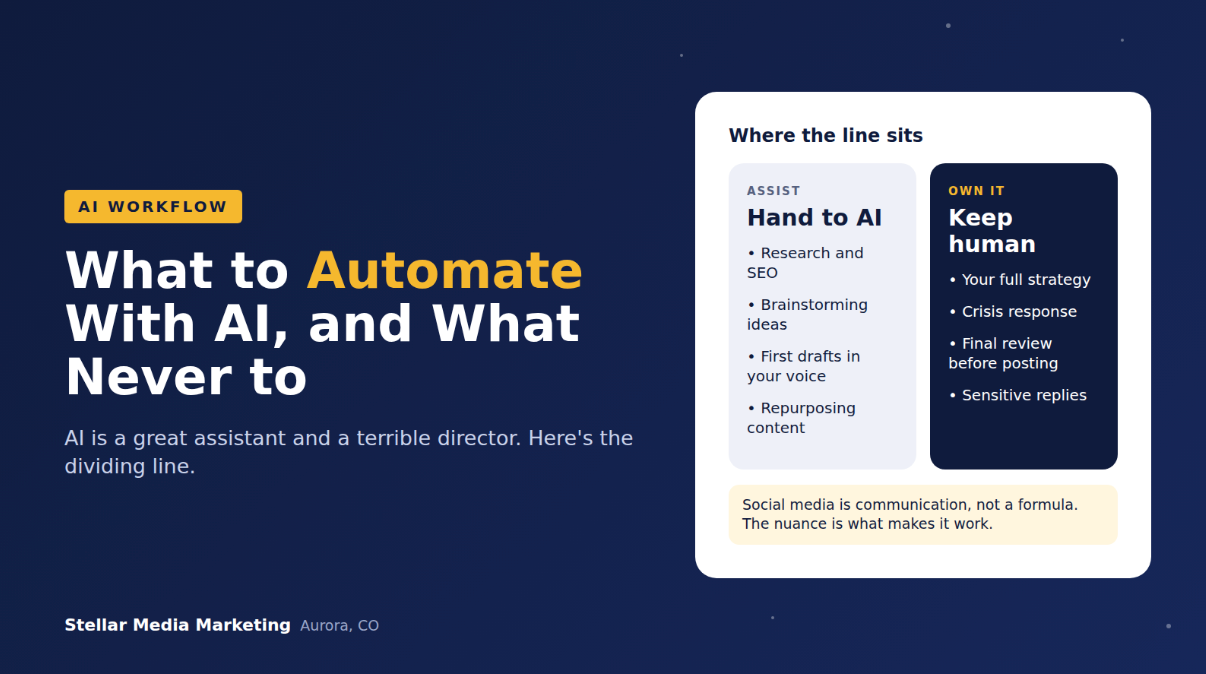
Automate the work that happens before the post and after it, not the judgment in the middle. In my own workflow, AI handles:
- Research. Industry-specific research for clients, so I show up knowing their world.
- SEO work. Finding updates I can make to my content and website for better search standings.
- Brainstorming. Content ideas, angles, and hooks, which I then cut down to the good ones.
- First drafts in my voice. I built a saved writing-voice setup so drafts start sounding like me instead of like a robot.
- Repurposing. One piece of content becoming a carousel, a caption, and a newsletter section.
- My weekly digest. The recurring content I produce every week runs on a repeatable system.
- Website help. Editing and improving pages without waiting on a developer for everything.
- Organization. A separate project for each client and side project, so the context stays where it belongs, including my podcast and my personal life.
That last one sounds small and isn't. Keeping each client's world separate is what keeps AI output specific instead of generic.
What should you never hand to AI?
Three things, and I'll defend all three.
- Your full strategy. AI can help you think, pull research, and pressure-test a plan. Hand it the whole strategy and it gets convoluted fast. Strategy needs judgment about your market, your margins, and your goals.
- Crisis situations. An unhappy customer, a bad review going sideways, a mistake your team made in public. Those need a person who understands the stakes.
- Posting without human oversight. Social media is communication, not a formula. The nuance is what makes it work. Nothing goes out unreviewed.
"AI is a fantastic assistant and a terrible director. It doesn't know which of your customers is about to churn, which project is your best proof, or when a joke will land wrong. Keep a human hand on the wheel." Kelly Noble Mirabella, Fractional Social Media Director and Founder, Stellar Media Marketing
Where does each task belong?
- Industry and competitor research. AI-assisted: Yes, drafts and summaries. Human-led: You decide what matters.
- Content ideas. AI-assisted: Yes, generate many. Human-led: You pick and sharpen.
- First drafts and captions. AI-assisted: Yes, in your saved voice. Human-led: You edit before it posts.
- SEO and website updates. AI-assisted: Yes, suggestions and copy. Human-led: You approve changes.
- Repurposing one post into many. AI-assisted: Yes. Human-led: You check each platform's fit.
- Strategy. AI-assisted: Support only. Human-led: You own it.
- Crisis response. AI-assisted: No. Human-led: You, immediately.
- Publishing. AI-assisted: Scheduling, yes. Human-led: Review before it goes live.
- Community replies. AI-assisted: Drafts for common questions. Human-led: You handle anything sensitive.
Why does unreviewed AI content backfire?
Because it reads like everyone else's, and because search engines are watching for it. Google's guidance on generative AI features tells publishers to create unique, useful content with real expertise rather than recycled information, and its spam policies target mass-produced content made without adding value.
The audience notices too. In the last 20 free social media audits I ran for Colorado businesses, nearly 60% had generic or ineffective content. Not all of it was AI, but generic is generic. If your post could belong to any business in your industry, it isn't doing its job.
The fix is proof. Real projects, real people, real numbers. That's the part AI can't invent for you, and it's the part your customers came for.
A simple AI workflow that keeps the human in charge
Here's the loop I use. It takes the speed of AI without giving up the judgment.
- Start with the business goal. What are we selling, to whom, and what does success look like this month?
- Research with AI. Industry updates, customer questions, competitor angles, SEO opportunities.
- Decide the plan yourself. Pick the themes, offers, and platforms. This is the step you own.
- Draft with AI in your voice. Give it your saved voice profile, real details, and actual project notes.
- Edit like a human. Cut the fluff, add the specifics only you know, fix the rhythm.
- Review before publishing. Every time.
- Watch the results and adjust. Then feed what worked back into the next round.
If batching your content is the bottleneck, that's a systems problem, not an AI problem. I wrote The No-Burnout Batching System about exactly that.
What about AI chatbots and DMs?
Automating conversations is different from automating content, and it's one of the best uses of AI for small businesses. A chatbot can answer repeat questions and capture leads at midnight, then hand off to you. I cover the decision in Does Your Small Business Website Need an AI Chatbot?
And if you want your business to show up when people ask AI tools for recommendations, that's a content and mentions game. I break it down in How to Get Your Business Mentioned in ChatGPT and Google AI Overviews.
Want help building a workflow that uses AI without sounding like it? See my services or book a discovery call.
Frequently asked questions
Is it okay to use AI to write social media posts?
Yes, for drafts. Give it your voice, your real details, and your goal, then edit before anything posts. Unedited AI content tends to sound generic, and generic content doesn't convert.
Will AI content hurt my SEO?
Not automatically. Google's guidance asks for unique, useful content with real expertise, and its spam policies target mass-produced pages made without adding value. Low-effort AI output tends to fall into that second category.
What's the biggest mistake businesses make with AI and social media?
Handing over strategy. AI is good at options and drafts, not at deciding what your business should be known for or which customer is worth chasing.
Should I tell people I use AI?
Be honest if asked, and never fake a human experience, like an AI-written testimonial or a fabricated result. Using AI to draft and organize is normal. Pretending an AI conversation was a person is not.
Can AI handle customer comments and DMs?
It can draft replies to common questions and run a chatbot for routine requests. Anything sensitive, emotional, or public and negative should go to a human right away.
How do I keep AI from making my content sound the same as everyone else's?
Feed it things only you have: project details, customer questions, local specifics, and your own numbers. Then edit. The specifics are what make content yours.
Changelog: September 2026, first published.