

Last updated: September 2026 · By Kelly Noble Mirabella, Fractional Social Media Director and Founder of Stellar Media Marketing (Aurora, CO)
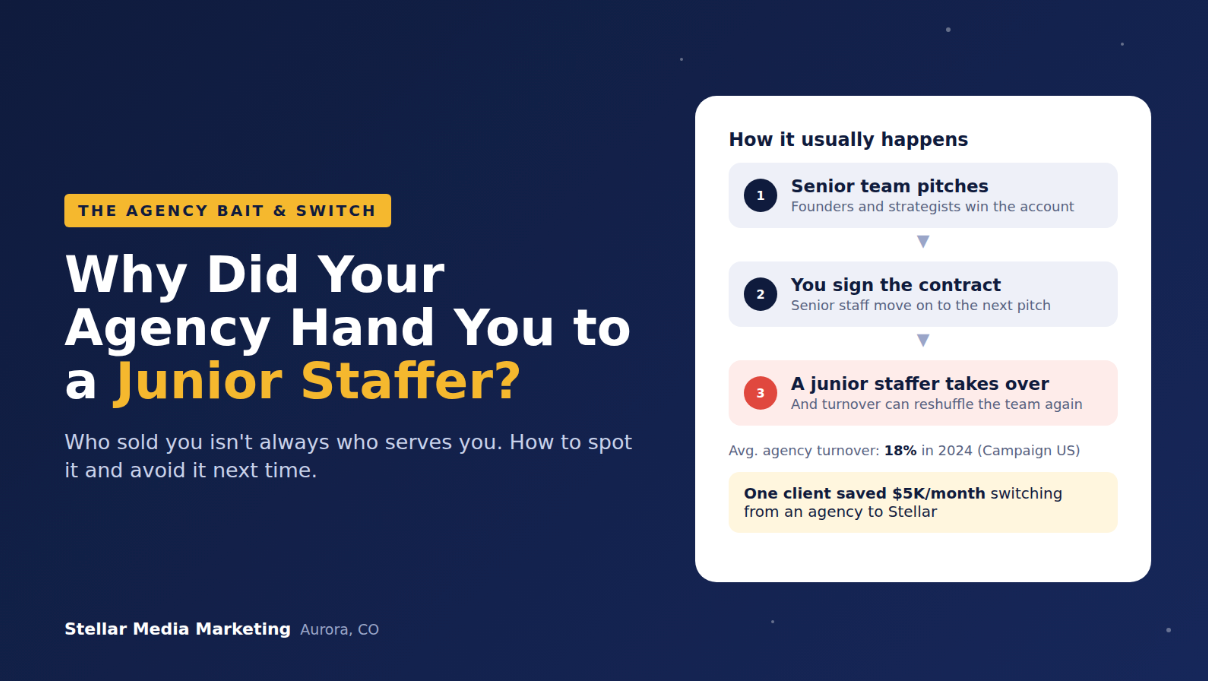
Quick answer: Most agencies use senior people to win accounts and junior people to run them, because that's how the agency business model makes money. It's often called the "bait and switch." Add agency turnover, which averaged 18% at a sample of North American agencies in 2024 (Campaign US), and your account can change hands more than once a year.
If that sounds familiar, you're not imagining it, and it's not always a bad agency. But it is something you can plan around. Here's why it happens and what to do about it.
Why do agencies put junior staff on client accounts?
Agencies put junior staff on accounts because senior time is expensive and has to be spread across many clients. The people with the most experience are usually busy selling, managing, and overseeing, not doing your daily work.
Here's how the model typically works:
- Senior leaders pitch. Founders, directors, and strategists show up to win the business. That's who you meet.
- The account is staffed for margin. Once you sign, the day-to-day work goes to coordinators and account managers with lower salaries, so the retainer is profitable. The gap is big: the U.S. Bureau of Labor Statistics reports median pay of $78,760 for marketing specialists (2025) versus $166,790 for marketing managers (May 2025).
- Senior people oversee from a distance. They may review a report or join a quarterly call, but they're stretched across many accounts.
- Turnover reshuffles the team. When someone leaves, your account gets handed to whoever has capacity.
None of that is illegal, and plenty of junior staff do great work. The problem is the gap between who sold you and who serves you.
Clients have told me agencies promised them the moon, then delivered generic, amateur content that made their social accounts go stale fast. By the time they came to me, they weren't just starting over on strategy. They were rebuilding trust with their own audience.
How common is agency turnover?
Turnover is a real part of agency life. A Campaign US review of North American agencies found average turnover dropped from 20% in 2023 to 18% in 2024, with some agencies as high as 28%. The same report notes the advertising and marketing industry has historically seen turnover estimated around 30%.
For you, that means a real chance your main contact changes within a year. Every change costs you time: re-explaining your business, your voice, your customers, and what didn't work last time.
What are the signs of an agency bait and switch?
The clearest sign is that the people doing your work aren't the people who sold it. Watch for these:
- You haven't talked to the person from the pitch since you signed. What it usually means: Senior staff moved on to the next pitch.
- Your account manager keeps changing. What it usually means: Turnover or reassignment.
- You have to explain your business again every few months. What it usually means: Knowledge isn't staying on your account.
- Strategy calls feel like status updates. What it usually means: No one senior is thinking about your account.
- Reports are full of metrics but no recommendations. What it usually means: Execution without direction.
- Content could belong to any business in your industry. What it usually means: Templates instead of strategy.
- Questions go "back to the team" and take days. What it usually means: The person you talk to can't make decisions.
That generic-content problem is one I see all the time. In my last 20 free social media audits, nearly 60% of businesses had content that was generic or just not doing its job, and 18 of the 20 had a stale Google Business Profile.
"You didn't hire the person you were talking to. That's the part nobody says out loud. You bought a senior strategist in the pitch meeting and got whoever had room on their plate the week you signed." Kelly Noble Mirabella, Fractional Social Media Director and Founder, Stellar Media Marketing
How do you avoid the bait and switch next time?
Ask direct questions before you sign, and get the answers in writing. These questions will tell you most of what you need to know:
- "Who specifically will work on my account each week?" Get names and titles.
- "How many other accounts does that person manage?" A number, not "it varies."
- "How often will I talk to the person who pitched me?" Monthly? Quarterly? Never?
- "What happens if my account manager leaves?" Ask about handoff notes and transition time.
- "Can the named team be written into the contract?" Some agencies will agree to key personnel terms.
- "What's your staff turnover rate?" A good agency will answer honestly.
For more on what to ask and what to expect, see How to Outsource Social Media Marketing the Right Way and Is a Digital Marketing Agency Worth It for Your Business?
What are the alternatives to a traditional agency?
If you want senior expertise on your account every month, you have more options than you used to. On a Harvard Business Review IdeaCast episode from August 2025, guests noted LinkedIn identified more than 110,000 fractional leaders in 2025, up from about 2,000 two years earlier. Your options include:
- A fractional social media director. One senior person, part time, who does or directs the work directly. This is what I do. Learn more in What Is a Fractional Social Media Director?
- A boutique agency with named senior staff. Smaller shops sometimes keep founders hands-on. Confirm it in writing.
- An independent consultant. Good for strategy, though you may need separate help to execute. See Marketing Agency vs Consultant.
- An in-house hire plus senior direction. Pair a coordinator with a fractional director so strategy doesn't depend on one junior employee. (More in Social Media Manager vs. Social Media Director.)
The fractional model can also cost less. One client who moved from an agency to Stellar saved $5,000 a month and got more specialized, personalized service in the process.
The fractional model changes who does the work. When I work with a client, the person on the discovery call is the person doing the work. I handle it all, from strategy to content to reporting, and most of my clients stay with me for two years or more. That consistency is part of why a North Texas outdoor kitchen builder I work with doubled its Facebook views to 212,000 in 2025 (up 100.9% from 2024): nobody had to relearn the brand halfway through the year.
Curious what that costs? Read How Much Does a Fractional Social Media Director Cost in 2026?, see my services, or book a discovery call.
Frequently asked questions
Is it normal for agencies to assign junior staff to accounts?
Yes. It's standard in the agency model, and it isn't automatically bad. It becomes a problem when you were sold senior expertise and don't get any senior attention after signing.
What should I do if my agency did a bait and switch?
Ask for a meeting with the senior person who pitched you. Share specific examples of what's missing, ask who owns your strategy, and request a written plan. If nothing changes, review your contract's exit terms.
Can I request a different account manager?
Usually, yes. Most agencies would rather reassign your account than lose it. Be specific about what you need, such as more industry knowledge, faster responses, or more strategic input.
How do I know if a marketing agency is legitimate?
Check reviews, ask for references from current clients in your industry, request examples of results with real numbers, and make sure the contract spells out deliverables, reporting, and exit terms.
Are freelancers or fractional directors less risky than agencies?
They carry different risks. You get more consistency because you work with one person, but that person has limited capacity. Ask about their backup plan for vacations or emergencies.
How long should I give an agency before switching?
Give a new agency about 90 days to learn your business and show early progress. If communication, strategy, or results are still missing by then, have a direct conversation about next steps.
Changelog: September 2026, first published.